Insulin Sensitivity Factor (ISF) & Correction Calculator
Calculate your correction factor and safe hyperglycemia insulin dosage
Calculation Results:
📌 Calculation Breakdown:
Understanding Correction Dosing and Your Insulin Sensitivity Factor (ISF)
Managing blood glucose effectively requires precision, especially when handling unexpected spikes in blood sugar (hyperglycemia). Whether caused by miscalculated dietary carbohydrates, temporary illness, physical stress, or missed medication, elevated glucose levels require prompt and calculated action.
The Insulin Sensitivity Factor & Correction Calculator by MyDiaCalc is designed to simplify this complex clinical process. By evaluating your total daily insulin requirements, current blood glucose levels, and active insulin on board (IOB), this tool provides an estimated Insulin Sensitivity Factor (ISF) and calculates a baseline correction dose to help safely restore glycemic balance.
🚨 CRITICAL MEDICAL DISCLAIMER & LIMITATION OF LIABILITY (1/3): MyDiaCalc, its developers, and operators DO NOT PROVIDE MEDICAL ADVICE. All calculations, formulas, and estimates generated by this tool are strictly for educational, informational, and reference purposes. MyDiaCalc EXPRESSLY DISCLAIMS ALL LIABILITY for any medical decisions, dosage adjustments, adverse health outcomes, or instances of severe hypoglycemia or hyperglycemia resulting from the use of this tool. Always consult your endocrinologist or certified diabetes educator to determine your personalized ISF, target glucose range, and correction insulin protocols.
What is the Insulin Sensitivity Factor (ISF)?
The Insulin Sensitivity Factor (ISF)—frequently referred to as the Correction Factor—is a key metric in intensive diabetes management. It represents the specific milligram per deciliter (\text{mg/dL}) or millimole per liter (\text{mmol/L}) drop in blood glucose expected from administering one single unit of rapid-acting or short-acting insulin.
For instance, if your calculated ISF is 50 mg/dL, taking 1\text{ unit} of rapid-acting insulin is anticipated to lower your blood glucose level by approximately 50\text{ mg/dL} over its active duration (typically 3 to 5 hours).
Understanding your ISF is essential for two major reasons:
- Preventing Under-Dosing: Administering too little insulin leaves blood glucose persistently elevated, increasing the risk of metabolic complications like Diabetic Ketoacidosis (DKA).
- Preventing Over-Dosing: Administering too much insulin causes rapid glucose drops, leading to severe insulin-induced hypoglycemia.
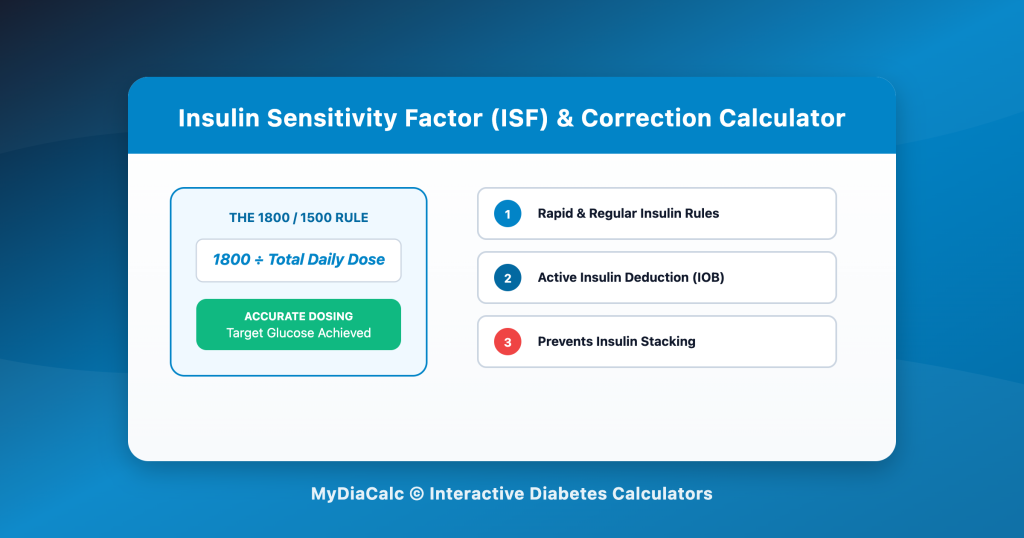
How ISF is Calculated: The 1800 and 1500 Clinical Rules
Endocrinologists estimate an individual’s ISF based on their Total Daily Dose (TDD) of insulin—the sum of all basal (background) and bolus (mealtime/correction) insulin taken in a 24-hour period.
1. The 1800 Rule (For Rapid-Acting Insulin)
Used for modern rapid-acting insulin analogs such as Insulin Lispro (Humalog), Insulin Aspart (Novolog), or Insulin Glulisine (Apidra):
\text{ISF (mg/dL)} = \frac{1800}{\text{Total Daily Dose (TDD)}}
Example: A person using a total of 40\text{ units} of insulin per day would have an estimated ISF of:
1800 \div 40 = 45\text{ mg/dL per unit}
2. The 1500 Rule (For Regular / Short-Acting Insulin)
Used for traditional Regular insulin (Humulin R, Novolin R):
\text{ISF (mg/dL)} = \frac{1500}{\text{Total Daily Dose (TDD)}}
🚨 IMPORTANT MEDICAL DISCLAIMER & LIMITATION OF LIABILITY (2/3): Insulin Stacking Warning: Rapid-acting insulin remains active in the body for 3 to 5 hours. Administering a second correction dose while previous insulin is still active is known as insulin stacking. Stacking insulin is a leading cause of severe nocturnal and daytime hypoglycemia. MyDiaCalc ASSUMES ZERO LIABILITY for complications arising from failure to account for active Insulin on Board (IOB).
Step-by-Step: How the Correction Dose Formula Works
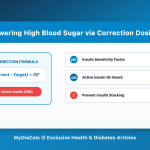
Calculating a safe correction dose involves comparing your current blood glucose reading against your target glucose reading, dividing that difference by your ISF, and subtracting any active insulin remaining from recent injections.
The Clinical Formula:
\text{Correction Dose (Units)} = \left( \frac{\text{Current Glucose} – \text{Target Glucose}}{\text{ISF}} \right) – \text{Active IOB}
Practical Example:
- Current Glucose: 250\text{ mg/dL}
- Target Glucose: 110\text{ mg/dL}
- Estimated ISF: 35\text{ mg/dL per unit}
- Active IOB: 1.0\text{ unit}
- Determine Glucose Elevation: 250 – 110 = 140\text{ mg/dL} over target.
- Calculate Raw Correction Units: 140 \div 35 = 4.0\text{ units}.
- Deduct Active IOB: 4.0 – 1.0 = \mathbf{3.0\text{ units}}.
Best Practices for Managing High Blood Sugar Safely
Beyond insulin correction, consider these crucial safety measures when handling high blood sugar levels:
- Hydrate Adequately: High blood glucose triggers osmotic diuresis, leading to frequent urination and dehydration. Drinking pure water helps your kidneys flush out excess glucose.
- Check for Ketones: If blood glucose exceeds 250\text{ mg/dL} (13.9\text{ mmol/L}), perform a blood or urine ketone test immediately.
- Avoid Exercise with High Ketones: While light activity can lower mild high sugar, vigorous exercise when ketones are present can cause stress hormone release, driving blood sugar dangerously higher.
| Feature / Scenario | Moderate High Glucose | Severe High Glucose |
| Blood Glucose Range | 180\text{ to }250\text{ mg/dL} | > 250\text{ mg/dL} |
| Primary Action | Calculate Correction Dose – Check IOB | Check Ketones + Hydrate + Correct |
| Monitoring Window | Re-check in 2–3 Hours | Re-check in 1–2 Hours |
🚨 FINAL MEDICAL DISCLAIMER & LIMITATION OF LIABILITY (3/3): By using MyDiaCalc, you expressly acknowledge and agree that health decisions, insulin administrations, and medical management are solely your responsibility. MyDiaCalc, its development team, and affiliated parties SHALL NOT BE HELD LIABLE for any indirect, incidental, or consequential damages resulting from the use of this software tool. Always follow the personalized guidelines provided by your clinical healthcare team.
Powered by MyDiaCalc © All Rights Reserved.