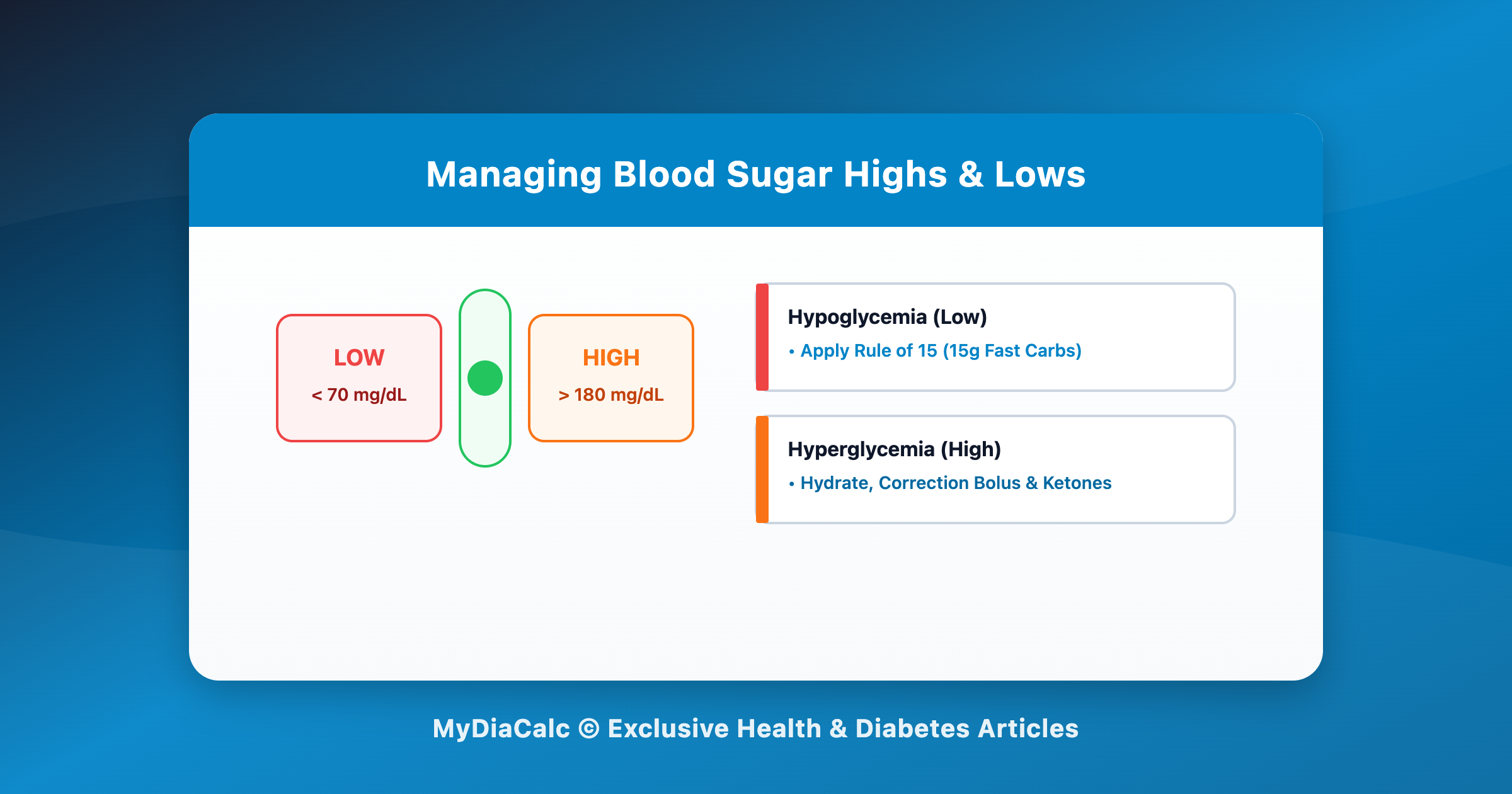
Hypoglycemia, or low blood sugar, is one of the most common acute complications in diabetes management. Defined clinically as a blood glucose reading below 70\text{ mg/dL} (3.9\text{ mmol/L}), a low blood sugar event requires swift and calculated action to prevent severe physiological consequences.
When treating low blood sugar, many individuals make the mistake of overeating out of panic or intense hunger. This often leads to severe rebound hyperglycemia—sending blood glucose levels soaring hours later.
To prevent this emotional and metabolic rollercoaster, medical professionals globally advocate for a standardized, evidence-based protocol: The 15-15 Rule.
In this comprehensive clinical guide, we will break down exactly how the 15-15 Rule works, why it is scientifically effective, the best fast-acting carbohydrate choices, and how to handle severe hypoglycemia safely.
🚨 CRITICAL MEDICAL DISCLAIMER & LIMITATION OF LIABILITY (1/3): MyDiaCalc, its owners, operators, and developers ARE NOT RESPONSIBLE OR LIABLE for any medical decisions, emergency outcomes, or health complications resulting from the use of this guide. All content and protocols provided here are strictly for educational and informational purposes only. They do not replace professional medical advice or individualized treatment plans. Severe hypoglycemia is a life-threatening medical emergency. Always consult your physician, endocrinologist, or certified diabetes care team regarding your personal hypoglycemia management protocols.
1. Understanding the Science: Why 15 Grams of Carbohydrates?
The human body absorbs simple, unrefined carbohydrates rapidly into the bloodstream through the small intestine. Clinical studies demonstrate that for an average adult, consuming 15 grams of fast-acting glucose raises blood glucose levels by approximately 30\text{ to }50\text{ mg/dL} (1.7\text{ to }2.8\text{ mmol/L}) within 15 to 20 minutes.
This specific quantity provides enough glucose to lift blood sugar safely above the hypoglycemia threshold (70\text{ mg/dL}) without overloading the metabolic system with excess calories that trigger subsequent high blood sugar spikes.
2. Step-by-Step Breakdown of the 15-15 Rule
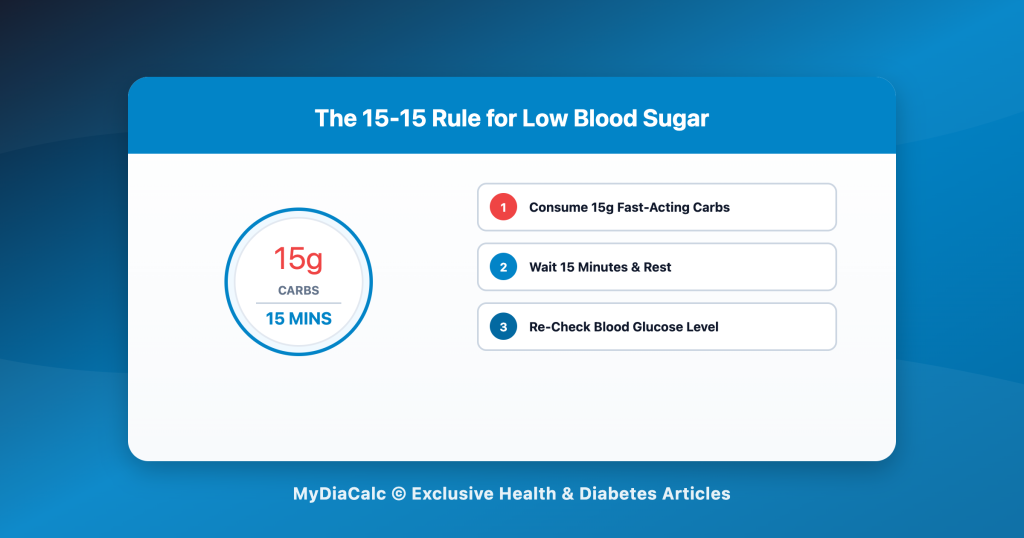
The protocol gets its name from its simple, two-step structure: Consume 15 grams of fast-acting carbohydrates, then wait 15 minutes to re-check your blood glucose.
┌─────────────────────────────────────────┐
│ STEP 1: Identify Hypoglycemia │
│ Blood Glucose < 70 mg/dL (3.9 mmol/L) │
└────────────────────┬────────────────────┘
▼
┌─────────────────────────────────────────┐
│ STEP 2: Consume 15g Fast-Acting Carbs │
│ (3-4 Glucose Tabs / 1/2 Cup Juice) │
└────────────────────┬────────────────────┘
▼
┌─────────────────────────────────────────┐
│ STEP 3: Rest & Wait 15 Minutes │
│ Allow glucose to absorb into bloodstream│
└────────────────────┬────────────────────┘
▼
┌─────────────────────────────────────────┐
│ STEP 4: Re-Test Blood Glucose │
└────────────────────┬────────────────────┘
│
┌─────────────┴─────────────┐
▼ ▼
[ < 70 mg/dL ] [ ≥ 70 mg/dL ]
│ │
▼ ▼
Repeat 15g Carbs + Eat a Sustaining
Wait 15 Mins Again Protein + Carb Snack
Detailed Execution Steps:
- Confirm Low Blood Sugar: Test your blood glucose with a glucometer or Continuous Glucose Monitor (CGM) to verify a reading below 70\text{ mg/dL}.
- Take Exactly 15 Grams of Fast-Acting Carbohydrates: Choose pure, fat-free simple sugars that digest rapidly.
- Wait 15 Minutes: Rest quietly. Do not eat or drink anything else during these 15 minutes, even if you still feel hungry or shaky.
- Re-Check Blood Glucose: Test your blood sugar again after 15 minutes.
- Evaluate & Repeat if Necessary: If your reading is still below 70\text{ mg/dL}, repeat the process with another 15 grams of fast carbs and wait another 15 minutes. Once blood sugar stabilizes above 70\text{ mg/dL}, consume a small snack containing protein and complex carbs (e.g., peanut butter on whole wheat) if your next meal is more than an hour away.
🚨 IMPORTANT MEDICAL DISCLAIMER & LIMITATION OF LIABILITY (2/3): Severe Hypoglycemia Warning: The 15-15 Rule applies ONLY to conscious individuals who are alert and able to swallow safely. If a person is unconscious, confused, uncooperative, or experiencing a seizure, NEVER attempt to place liquids, food, or glucose products in their mouth due to high aspiration and choking hazards. Administer emergency nasal or injectable Glucagon if trained and call emergency medical services immediately. MyDiaCalc DISCLAIMS ALL RESPONSIBILITY for treatment delays or emergency management outcomes.
3. What Counts as 15 Grams of Fast-Acting Carbohydrates?
Speed of digestion is crucial during hypoglycemia. Fat, protein, and dietary fiber slow down gastric emptying, delaying the absorption of sugar into the bloodstream.
✅ Ideal 15-Gram Options (Fast-Acting):
- Glucose Tablets: 3 to 4 chewable tablets (check label packaging for exact dosing).
- Fruit Juice: 1/2\text{ cup} (120\text{ mL}) of orange, apple, or grape juice.
- Regular Soda: 1/2\text{ cup} (120\text{ mL}) of non-diet, regular soft drink.
- Pure Honey or White Sugar: 1 tablespoon of honey or white sugar dissolved in a little water.
- Glucose Gel: 1 tube of specialized medical glucose gel.
❌ What to Avoid During Hypoglycemia:
- Chocolate & Candy Bars: High fat content slows down sugar absorption.
- Ice Cream & Whole Milk: Proteins and fats delay gastric emptying.
- Pastries & Baked Goods: High fat content retards glucose elevation.
4. Quick Reference Matrix: Treating Hypoglycemia by Severity
| Severity Level | Blood Glucose Reading | Common Symptoms | Recommended Clinical Action |
| Level 1 (Mild) | 54 – 69\text{ mg/dL} (3.0 – 3.8\text{ mmol/L}) | Shakiness, sweating, fast heart rate | Apply standard 15-15 Rule (15\text{g} fast carbs). |
| Level 2 (Moderate) | < 54\text{ mg/dL} (3.0\text{ mmol/L}) | Confusion, irritability, dizziness | Consume 15\text{g} – 20\text{g} fast carbs immediately; re-test in 15 mins. |
| Level 3 (Severe) | Varied (Cognitive Impairment) | Inability to self-treat, unconsciousness, seizure | Medical Emergency! Administer Glucagon; call Emergency Services. |
🚨 FINAL MEDICAL DISCLAIMER & LIMITATION OF LIABILITY (3/3): By utilizing MyDiaCalc and reading this clinical guide, you explicitly agree that MyDiaCalc and its management assume ZERO LIABILITY OR RESPONSIBILITY for your personal health decisions, medical outcomes, or treatment choices. Diabetes care requires ongoing clinical supervision. Always consult your endocrinologist or certified diabetes care team for individualized medical advice.
Content & Calculators Powered by MyDiaCalc © All Rights Reserved.