Hyperglycemia—abnormally high blood glucose—is an inevitable challenge in diabetes management. Elevated blood sugar levels can result from underestimated carbohydrate consumption, illness, physical inactivity, emotional stress, or missed medication doses. Left uncorrected, sustained high blood sugar increases the risk of acute metabolic complications such as Diabetic Ketoacidosis (DKA) and Hyperosmolar Hyperglycemic State (HHS).
Lowering blood glucose safely requires calculating and administering a correction dose of rapid-acting or short-acting insulin. However, improper correction protocols can lead to erratic blood sugar swings or dangerous severe hypoglycemia. This guide provides an evidence-based roadmap for mastering correction dosing safely and effectively.
🚨 CRITICAL MEDICAL DISCLAIMER & LIMITATION OF LIABILITY (1/3): MyDiaCalc, its owners, operators, and developers ARE NOT RESPONSIBLE OR LIABLE for any medical decisions, insulin dosage adjustments, emergency outcomes, or health complications resulting from the use of this guide or related calculation tools. All content, formulas, and protocols provided here are strictly for educational and informational purposes only. They do not constitute professional medical advice, clinical diagnosis, or individualized treatment plans. Always consult your endocrinologist or certified diabetes care team regarding your personalized Insulin Sensitivity Factor (ISF), target glucose ranges, and correction insulin protocols.
1. The Fundamentals of Correction Dosing
A correction dose is an additional amount of rapid-acting insulin administered specifically to bring elevated blood glucose levels back into a safe target range. Unlike mealtime insulin (bolus), which covers incoming dietary carbohydrates, correction insulin targets glucose already present in the bloodstream.
To accurately calculate a correction dose, two clinical variables are required:
- Target Blood Glucose Level: The ideal glucose range set by your physician (typically around 100\text{ to }120\text{ mg/dL} or 5.5\text{ to }6.7\text{ mmol/L}).
- Insulin Sensitivity Factor (ISF) / Correction Factor: The amount by which one unit of rapid-acting insulin is expected to lower your blood glucose level.
2. Understanding Your Insulin Sensitivity Factor (ISF)
Your Insulin Sensitivity Factor (ISF) determines how sensitive your body is to insulin. For example, an ISF of 50 means that 1 unit of rapid-acting insulin will reduce your blood glucose by approximately 50\text{ mg/dL} (2.8\text{ mmol/L}).
The 1800 / 1500 Clinical Rule
Healthcare providers often estimate ISF based on an individual’s Total Daily Dose (TDD) of insulin:
\text{ISF (mg/dL) for Rapid-Acting Insulin} = \frac{1800}{\text{Total Daily Dose (TDD)}} \text{ISF (mg/dL) for Regular Insulin} = \frac{1500}{\text{Total Daily Dose (TDD)}}
Example: If an individual uses a total of 40 units of insulin per day (basal + bolus combined), their estimated ISF with rapid-acting insulin would be 1800 \div 40 = 45\text{ mg/dL per unit}.
🚨 IMPORTANT MEDICAL DISCLAIMER & LIMITATION OF LIABILITY (2/3): Insulin Stacking Warning: Rapid-acting insulin remains active in the body for 3 to 5 hours (Active Insulin Time / Duration of Insulin Action). Administering multiple correction doses within a short window—known as insulin stacking—can lead to severe, unpredictable hypoglycemia. Always calculate active Insulin on Board (IOB) before administering additional correction units. MyDiaCalc EXPRESSLY DISCLAIMS ALL LIABILITY for adverse outcomes related to improper insulin dosing or insulin stacking.
3. The Clinical Correction Formula
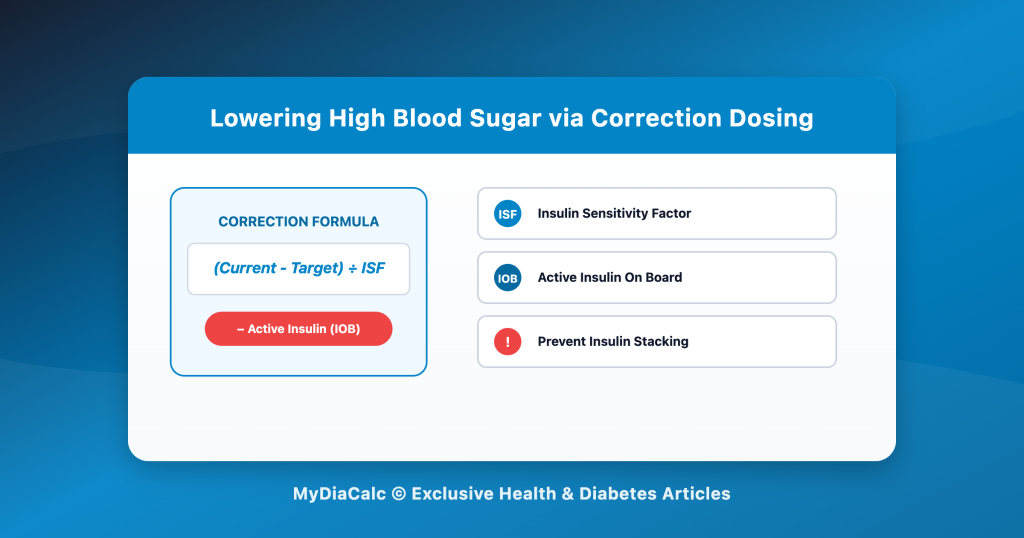
Once your current blood sugar, target blood sugar, ISF, and Active Insulin on Board (IOB) are known, the required correction dose can be calculated using the standardized formula:
\text{Correction Dose (Units)} = \left( \frac{\text{Current Glucose} – \text{Target Glucose}}{\text{ISF}} \right) – \text{Active IOB}
Step-by-Step Calculation Example:
- Current Blood Glucose: 250\text{ mg/dL}
- Target Blood Glucose: 110\text{ mg/dL}
- Insulin Sensitivity Factor (ISF): 35\text{ mg/dL per unit}
- Active Insulin on Board (IOB): 1.0\text{ unit}
Calculation Steps:
- Calculate raw glucose elevation: 250\text{ mg/dL} – 110\text{ mg/dL} = 140\text{ mg/dL} over target.
- Divide by ISF: 140 \div 35 = 4.0\text{ units}.
- Subtract Active IOB: 4.0\text{ units} – 1.0\text{ unit} = \mathbf{3.0\text{ units of insulin}}.
4. Essential Safety Guidelines During Correction
To safely lower elevated blood glucose without causing severe low blood sugar or metabolic instability, adhere to these clinical best practices:
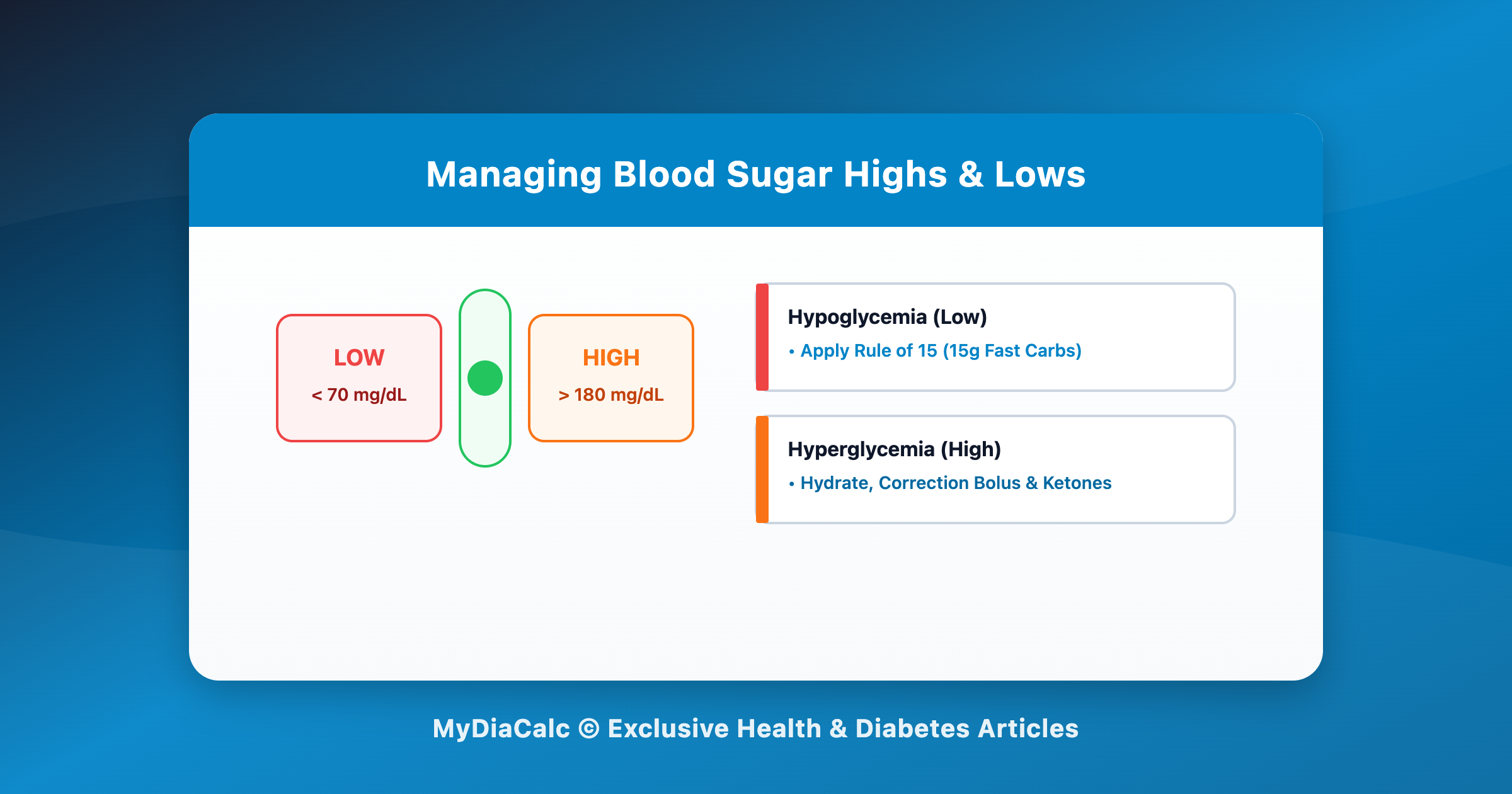
- Hydrate with Pure Water: High blood sugar leads to osmotic diuresis (frequent urination), causing dehydration. Drinking ample water helps the kidneys filter out excess glucose through urine.
- Avoid Strenuous Exercise with High Glucose / Ketones: If blood sugar is above 250\text{ mg/dL} (13.9\text{ mmol/L}) with moderate-to-high ketones present, vigorous exercise can stimulate stress hormones (cortisol, adrenaline) and elevate blood sugar further.
- Check for Ketones: When blood sugar exceeds 250\text{ mg/dL}, test blood or urine for ketones to rule out Diabetic Ketoacidosis (DKA).
- Wait for Full Insulin Duration: Allow at least 3 to 4 hours after a correction dose before evaluating whether another correction is necessary.
5. Quick Reference Matrix: Correction Scenarios
| Scenario | Blood Glucose Reading | Primary Risk | Recommended Protocol |
| Mild High | 180 – 240\text{ mg/dL} | Progressive fatigue, thirst | Calculate standard correction dose; drink 500\text{ mL} water. |
| Moderate High | 241 – 300\text{ mg/dL} | Dehydration, early ketone buildup | Calculate correction dose accounting for IOB; test for ketones; hydrate. |
| Severe High | > 300\text{ mg/dL} | DKA, hyperosmolar state | Administer correction dose; test ketones immediately; contact provider if persistent. |
🚨 FINAL MEDICAL DISCLAIMER & LIMITATION OF LIABILITY (3/3): By utilizing MyDiaCalc and reading this clinical guide, you explicitly agree that MyDiaCalc and its management assume ZERO LIABILITY OR RESPONSIBILITY for your personal health decisions, medical outcomes, or dosage choices. Diabetes care requires ongoing clinical supervision. Always consult your endocrinologist or certified diabetes care team for individualized medical advice.
Content & Calculators Powered by MyDiaCalc © All Rights Reserved.