Living with diabetes requires maintaining a delicate metabolic balance. Blood glucose levels naturally fluctuate throughout the day in response to meals, physical activity, stress, illness, and medication timing. However, when blood sugar swings outside the recommended target range, individuals face two primary acute clinical states: Hypoglycemia (abnormally low blood sugar) and Hyperglycemia (abnormally high blood sugar).
Knowing how to identify the early warning signs of both extremes, understanding their underlying physiological triggers, and executing precise, evidence-based correction protocols is essential for preventing emergency room visits and maintaining long-term cardiovascular and metabolic health.
In this comprehensive medical guide, we will break down the step-by-step strategies for managing both blood sugar highs and lows safely, effectively, and with clinical confidence.
🚨 CRITICAL MEDICAL DISCLAIMER & LIMITATION OF LIABILITY (1/3): MyDiaCalc, its owners, operators, and developers ARE NOT RESPONSIBLE OR LIABLE for any medical decisions, dosage adjustments, emergency outcomes, or health complications resulting from the use of this guide or related calculation tools. All content, guidelines, and protocols provided here are strictly for educational and informational purposes only. They do not constitute professional medical advice, clinical diagnosis, or individualized treatment plans. Severe hypoglycemia and diabetic ketoacidosis (DKA) are life-threatening medical emergencies. Always consult your physician, endocrinologist, or certified diabetes care team regarding your personalized target ranges and insulin correction protocols.
1. Understanding the Spectrum: Highs vs. Lows
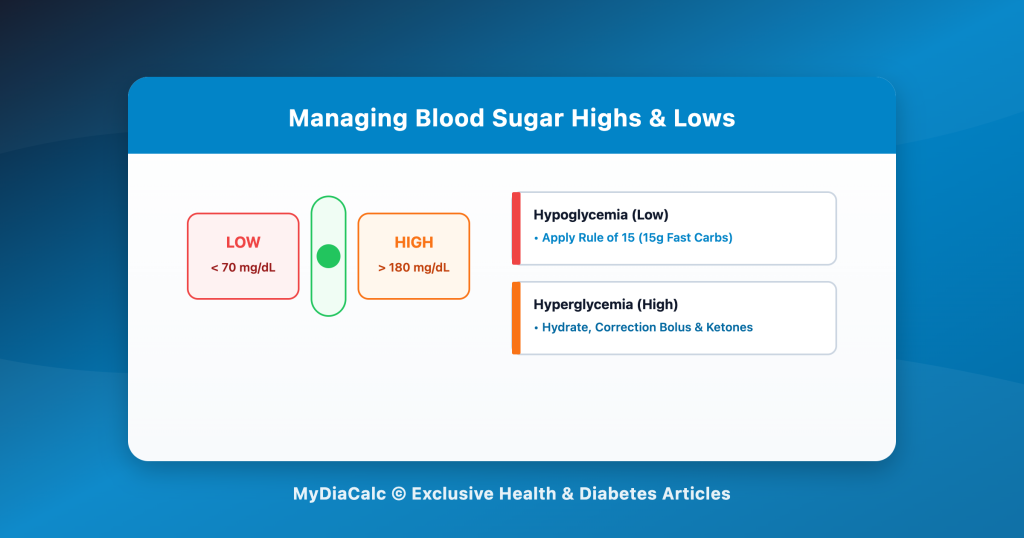
To manage blood sugar effectively, it helps to visualize glycemic control as a continuous spectrum. Clinical guidelines established by the American Diabetes Association (ADA) define standard glycemic thresholds for non-pregnant adults as follows:
HYPOGLYCEMIA TARGET RANGE HYPERGLYCERMIA
┌─────────────────┐ ┌─────────────────┐ ┌─────────────────┐
│ < 70 mg/dL │ ◄───► │ 70-180 mg/dL │ ◄────►│ > 180 mg/dL │
│ (< 3.9 mmol/L) │ │ (3.9-10.0 mmol/L)│ │ (> 10.0 mmol/L) │
└─────────────────┘ └─────────────────┘ └─────────────────┘
Emergency Action Optimal Health Correction Needed
- Target Fasting Range: 80\text{ to }130\text{ mg/dL} (4.4\text{ to }7.2\text{ mmol/L}).
- Target Post-Meal Range (2 hours postprandial): Below 180\text{ mg/dL} (10.0\text{ mmol/L}).
2. Managing Hypoglycemia (Low Blood Sugar)
Hypoglycemia is clinically defined as a blood glucose reading dropping below 70\text{ mg/dL} (3.9\text{ mmol/L}). Because the brain relies almost exclusively on circulating glucose for fuel, rapid recognition and immediate treatment are critical.
A. Common Triggers of Low Blood Sugar
- Excessive Insulin / Medication: Administering more rapid-acting insulin than needed for a carbohydrate load.
- Unplanned Physical Activity: Exercise increases cellular insulin sensitivity, driving glucose rapidly into muscle tissue.
- Skipped or Delayed Meals: Peak insulin action occurring without adequate food absorption.
- Alcohol Intake: Alcohol temporarily blocks the liver’s ability to release stored glycogen into the bloodstream.
B. Recognizing the Symptoms
Symptoms are categorized into two neuro-physiological stages:
- Adrenergic Symptoms (Early Warning): Shakiness, sudden sweating, pale skin, rapid heartbeat (tachycardia), anxiety, and intense hunger.
- Neuroglycopenic Symptoms (Brain Glucose Depletion): Confusion, dizziness, slurred speech, blurred vision, loss of coordination, and eventually loss of consciousness if untreated.
C. Step-by-Step Action Plan: The Clinical “Rule of 15”
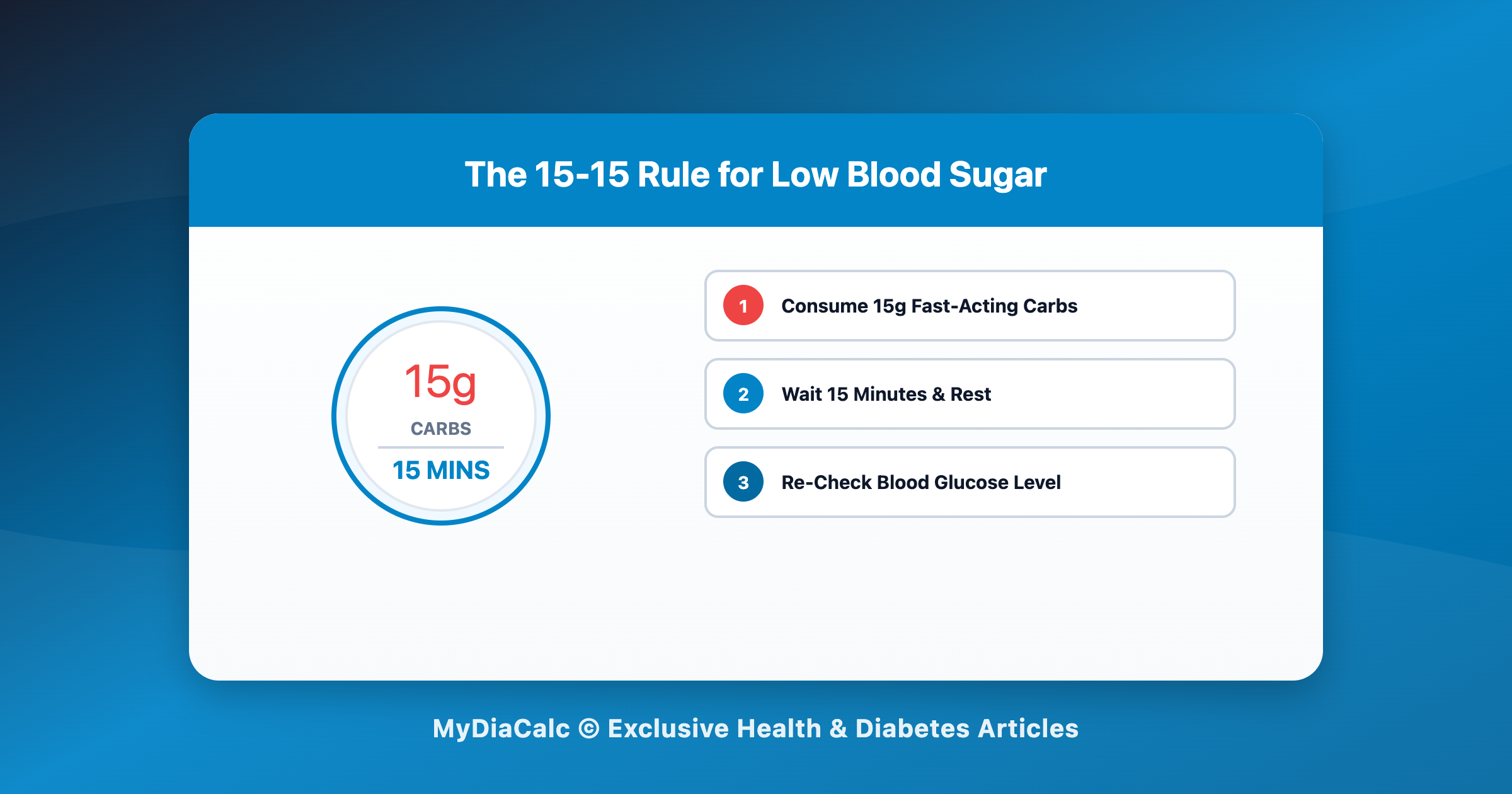
When dealing with mild-to-moderate low blood sugar (person is conscious and able to swallow), follow the standard clinical Rule of 15:
┌───────────────────────────┐
│ 1. Consume 15g Fast Carbs │
└─────────────┬─────────────┘
▼
┌───────────────────────────┐
│ 2. Wait 15 Minutes │
└─────────────┬─────────────┘
▼
┌───────────────────────────┐
│ 3. Re-Check Blood Glucose │
└─────────────┬─────────────┘
│
┌──────┴──────┐
▼ ▼
[ < 70 mg/dL ] [ ≥ 70 mg/dL ]
│ │
▼ ▼
Repeat Rule Eat a Small Protein
of 15 + Carb Snack/Meal
What Counts as 15 Grams of Fast-Acting Carbohydrates?
- 3\text{ to }4 chewable glucose tablets.
- 1/2\text{ cup} (120\text{ mL}) of fruit juice (e.g., orange or apple juice).
- 1/2\text{ cup} (120\text{ mL}) of regular (non-diet) soda.
- 1\text{ tablespoon} of pure honey or white sugar dissolved in water.
❌ CRITICAL NOTE: Avoid chocolates, pastries, ice cream, or milk when treating low blood sugar. The high fat and protein content in these foods significantly delays gastric emptying and carbohydrate absorption, prolonging hypoglycemia.
🚨 IMPORTANT MEDICAL DISCLAIMER & LIMITATION OF LIABILITY (2/3): For Severe Hypoglycemia (Level 3): If an individual becomes unconscious, unresponsive, or suffers a seizure due to severe hypoglycemia, NEVER attempt to pour liquid or place food in their mouth, as this poses a high risk of choking/aspiration. Administer emergency Glucagon (via nasal spray or auto-injector) if trained, turn the person on their side, and dial emergency medical services immediately. MyDiaCalc EXPRESSLY DISCLAIMS ALL RESPONSIBILITY for treatment delays or emergency management outcomes.
3. Managing Hyperglycemia (High Blood Sugar)
Hyperglycemia occurs when blood glucose levels rise above target limits—typically defined as fasting blood sugar > 130\text{ mg/dL} or post-meal blood sugar > 180\text{ mg/dL} (10.0\text{ mmol/L}).
A. Common Triggers of High Blood Sugar
- Insufficient Insulin or Missed Dose: Forgetting a mealtime bolus or underestimating carbohydrate intake.
- Overestimating Carbohydrate Intake: Consuming a high-glycemic meal without adequate coverage.
- Illness, Infection, or Surgery: Physiological stress releases cortisol and adrenaline, which induce temporary insulin resistance.
- Emotional Stress: Stress hormones prompt the liver to release stored glucose into the bloodstream.
- Sedentary Behavior: Inactivity reduces cellular glucose uptake.
- Expired or Damaged Insulin: Insulin exposed to extreme heat or freezing temperatures loses potency.
B. Recognizing the Symptoms
Hyperglycemia usually develops slowly over hours or days:
- Excessive thirst (polydipsia) and dry mouth.
- Frequent urination (polyuria), especially waking up multiple times at night.
- Persistent fatigue and lethargy.
- Blurred vision and headaches.
C. Step-by-Step Action Plan: Safely Correcting High Blood Sugar
When facing elevated glucose, taking structured, calculated steps prevents dangerous over-corrections:
1. Calculate Your Insulin Correction Bolus (If Prescribed)
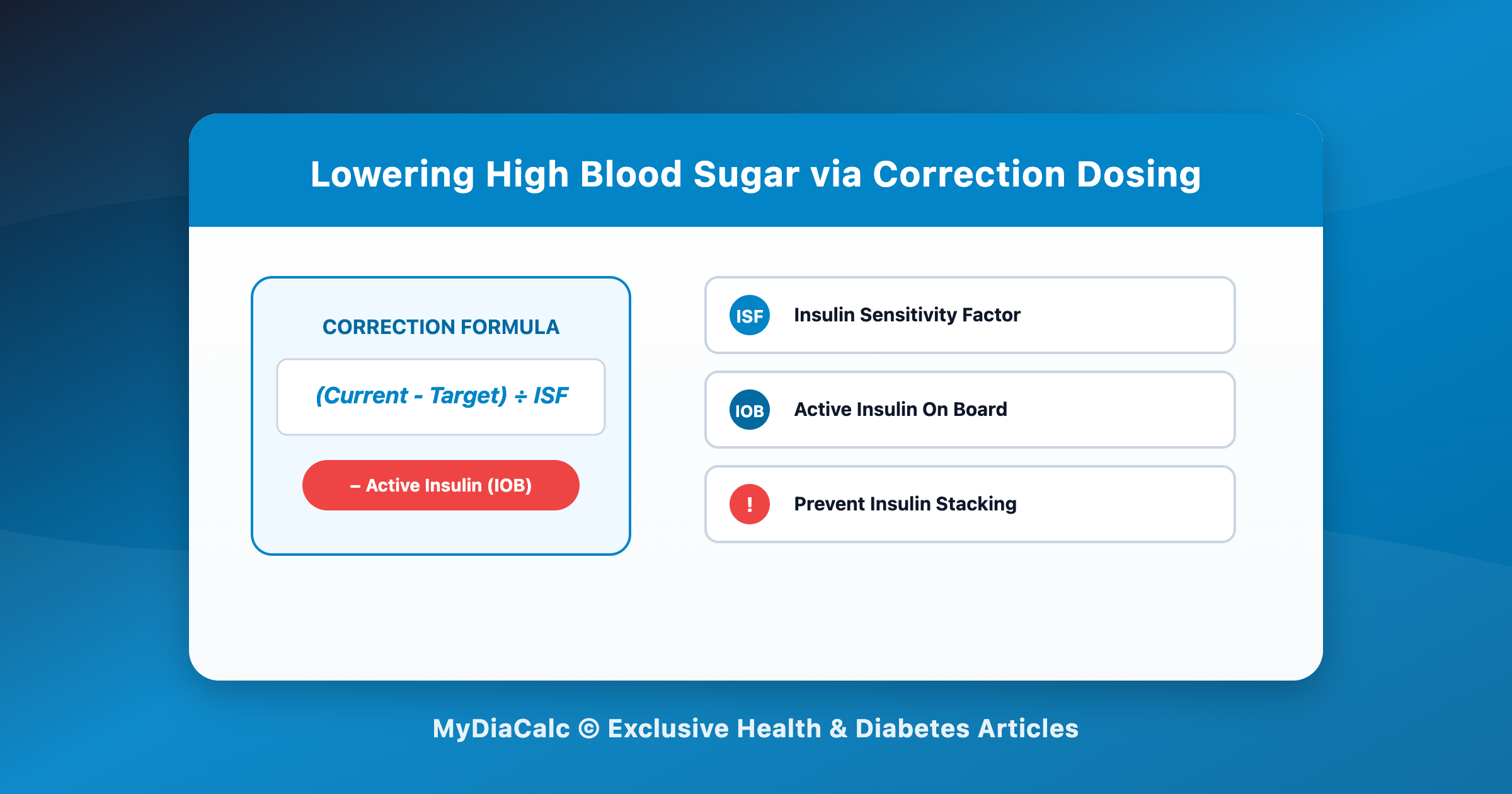
If you use rapid-acting insulin, calculate a correction dose using your clinical Insulin Sensitivity Factor (ISF) or Correction Factor (CF):
\text{Correction Dose (Units)} = \frac{\text{Current Glucose} – \text{Target Glucose}}{\text{Insulin Sensitivity Factor (ISF)}}
- Example: If current glucose is 250\text{ mg/dL}, target is 100\text{ mg/dL}, and ISF is 50:
\text{Correction Dose} = \frac{250 – 100}{50} = \frac{150}{50} = 3\text{ Units}
2. Beware of “Insulin Stacking”
Always account for Insulin on Board (IOB)—the amount of active rapid-acting insulin remaining from previous doses (which stays active for 3 to 5 hours). Administering additional correction doses too soon causes stacked insulin effects, leading to severe rebound hypoglycemia.
3. Hydrate Aggressively with Water
Drinking plenty of plain water helps the kidneys filter and excrete excess glucose out of the body via urine, while preventing dehydration caused by osmotic diuresis.
4. Light Physical Activity (With Caution)
A 15 to 20-minute light walk can significantly increase muscle glucose uptake and lower blood sugar.
- ⚠️ Warning: Do NOT exercise if your blood glucose is above 250\text{ mg/dL} (13.9\text{ mmol/L}) AND ketones are present, as physical exertion in a ketone state accelerates muscle breakdown and worsens metabolic acidosis.
4. Ketones & Diabetic Ketoacidosis (DKA) Warning
Diabetic Ketoacidosis (DKA) is a severe, life-threatening metabolic complication that primarily affects individuals with Type 1 diabetes (and occasionally Type 2 under extreme stress or illness). DKA occurs when the body lacks sufficient insulin to process glucose, forcing it to break down fat rapidly for fuel, which produces toxic acidic compounds known as ketones.
When Should You Test for Ketones?
Check blood or urine ketones whenever:
- Blood glucose exceeds 250\text{ mg/dL} (13.9\text{ mmol/L}) twice consecutively.
- You experience symptoms of illness, nausea, vomiting, or abdominal pain.
Ketone Level Interpretation Matrix:
| Ketone Level (Blood) | Level Severity | Clinical Action Required |
| < 0.6\text{ mmol/L} | Normal | Target range; continue routine management. |
| 0.6 – 1.5\text{ mmol/L} | Low to Moderate | Drink water, administer correction insulin, re-test in 2 hours. |
| 1.6 – 3.0\text{ mmol/L} | High | Contact your endocrinologist or medical team immediately. |
| > 3.0\text{ mmol/L} | Severe / Critical | Emergency! Go to the nearest Emergency Room immediately. |
5. Summary Reference Table: Highs vs. Lows Management
| Feature | Hypoglycemia (Low Blood Sugar) | Hyperglycemia (High Blood Sugar) |
| Threshold | < 70\text{ mg/dL} (3.9\text{ mmol/L}) | > 180\text{ mg/dL} (10.0\text{ mmol/L}) |
| Onset | Fast (minutes to hours) | Slow (hours to days) |
| Key Symptoms | Shakiness, sweating, confusion, hunger | Thirst, frequent urination, fatigue, blurred vision |
| Immediate Action | Apply Rule of 15 (15\text{g} fast carbs) | Hydrate, calculate correction insulin, check ketones |
| Re-Test Timing | Re-check in 15 minutes | Re-check in 2 to 3 hours |
| Main Risk | Seizure, loss of consciousness | DKA, dehydration, long-term vascular damage |
🚨 FINAL MEDICAL DISCLAIMER & LIMITATION OF LIABILITY (3/3): By utilizing MyDiaCalc and reading this clinical guide, you explicitly agree that MyDiaCalc and its management assume ZERO LIABILITY OR RESPONSIBILITY for your personal health decisions, medical outcomes, or dosage choices. Diabetes management requires continuous medical supervision. Always consult your healthcare provider for individualized medical advice.
Content & Calculators Powered by MyDiaCalc © All Rights Reserved.