eAG & A1c Converter
Understanding eAG (Estimated Average Glucose): Bridging Continuous Monitoring and HbA1c Results
For decades, the Hemoglobin A1c (HbA1c) test has served as the gold standard for assessing long-term glycemic control in individuals with diabetes. Expressed as a percentage, HbA1c reflects the proportion of hemoglobin proteins in red blood cells that have bonded with glucose over a 2 to 3-month lifespan.
However, daily diabetes management relies on glucose measurements expressed in mg/dL or mmol/L via self-monitoring glucometers or Continuous Glucose Monitors (CGM). This difference in measurement units often creates confusion.
To bridge this gap, clinical organizations established the Estimated Average Glucose (eAG) metric, allowing patients and clinicians to translate HbA1c percentages directly into daily blood glucose averages.
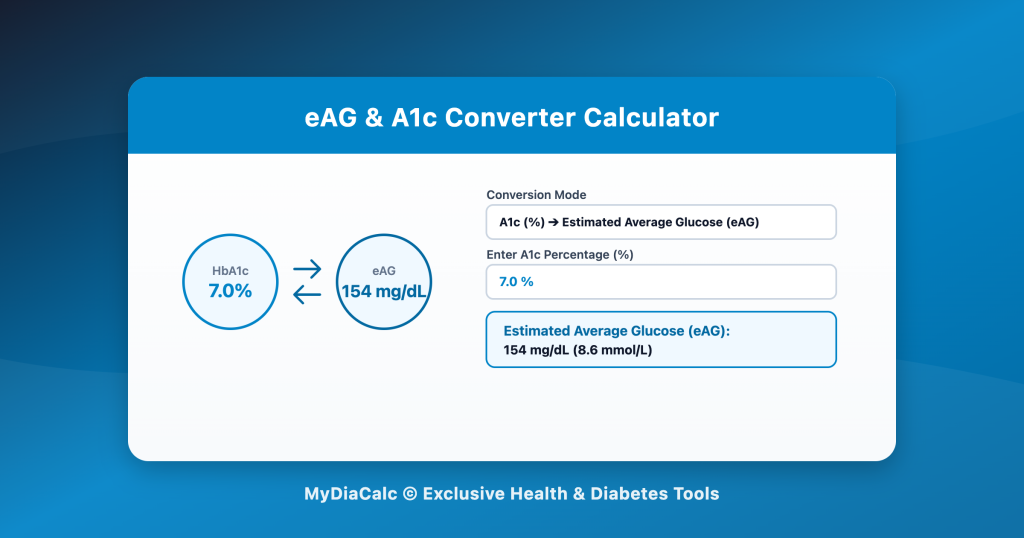
The eAG & A1c Converter on MyDiaCalc provides instant mathematical conversion between HbA1c values and daily average blood glucose levels using clinically validated standard formulas.
🚨 CRITICAL MEDICAL DISCLAIMER & LIMITATION OF LIABILITY (1/3): MyDiaCalc, its owners, and operators DISCLAIM ALL LEGAL AND MEDICAL LIABILITY for clinical decisions or health outcomes based on eAG calculations. The Estimated Average Glucose (eAG) is a calculated estimate derived from population-based research data. Individual physiological variables—such as red blood cell lifespan, hemoglobin variants, anemia, or kidney disease—can cause actual blood glucose averages to deviate from calculated eAG results.
1. The Science Behind eAG: The ADAG Study Formula
The mathematical relationship linking HbA1c to average glucose levels was defined by the landmark A1c-Derived Average Glucose (ADAG) Study, conducted by the American Diabetes Association (ADA) in partnership with international health organizations.
The study established the standard linear regression equation used worldwide:
\text{eAG (mg/dL)} = 28.7 \times \text{HbA1c (\%)} – 46.7
This equation allows seamless mathematical conversion between three-month laboratory HbA1c tests and daily home monitoring measurements.
2. Reference Table: HbA1c to Estimated Average Glucose (eAG)
| HbA1c (%) | eAG (mg/dL) | eAG (mmol/L) | Clinical Interpretation |
| 5.0 | 97 | 5.4 | Normal / Non-diabetic baseline |
| 6.0 | 126 | 7.0 | Prediabetes threshold / Optimal control |
| 7.0 | 154 | 8.6 | Standard target for most non-pregnant adults |
| 8.0 | 183 | 10.2 | Moderate elevation / Regimen review recommended |
| 9.0 | 212 | 11.8 | Elevated risk of vascular complications |
| 10.0 | 240 | 13.3 | High risk / Requires clinical intervention |
🚨 IMPORTANT MEDICAL DISCLAIMER & LIMITATION OF LIABILITY (2/3): MyDiaCalc DOES NOT GUARANTEE that calculated eAG values perfectly reflect your true blood sugar average. Home glucometer readings capture specific static moments throughout the day and may miss postprandial spikes or nocturnal dips, leading to differences between calculated eAG and recorded logbook averages.
3. Why eAG Matters for Daily Diabetes Management
Translating HbA1c percentages into eAG provides key clinical advantages:
- Unit Consistency: Patients track their health using familiar metrics (\text{mg/dL} or \text{mmol/L}) that match daily glucometer and Continuous Glucose Monitor (CGM) readings.
- Improved Goal Setting: Understanding that reducing HbA1c from 8.0\% to 7.0\% means bringing daily average sugar down by roughly 29\text{ mg/dL} makes therapy adjustments more practical.
- Enhanced Patient-Clinician Communication: Translates abstract lab percentages into actionable daily numbers during clinical checkups.
4. Factors That Can Cause Discrepancies Between eAG and Actual A1c
While the eAG mathematical model is highly accurate for most individuals, specific medical conditions can skew the relationship between blood glucose levels and HbA1c:
- Hemoglobin Variants: Conditions such as sickle cell trait or thalassemia.
- Red Blood Cell Turnover Rates: Anemia or blood loss can falsely lower HbA1c readings, whereas iron deficiency can falsely elevate them.
- Kidney Disease or Pregnancy: Altered red cell survival rates during end-stage renal disease or pregnancy can affect HbA1c accuracy.
🚨 FINAL MEDICAL DISCLAIMER & LIMITATION OF LIABILITY (3/3): By accessing and using MyDiaCalc, you explicitly agree that the platform, developers, and administrators assume NO LIABILITY FOR ANY DIRECT OR INDIRECT DAMAGES, INJURIES, OR LOSSES resulting from calculator use. Always review your lab results and glycemic targets directly with a qualified medical professional.
Content & Calculators Powered by MyDiaCalc © All Rights Reserved.