Glucose Unit Converter
The Global Guide to Blood Glucose Units: How to Convert Between mg/dL and mmol/L Accurately
Blood glucose values are measured and reported using two different standard units of measurement depending on geographic location and healthcare traditions. In the United States, Japan, France, and many Middle Eastern countries, blood sugar is primarily measured in milligrams per deciliter (mg/dL). Conversely, in the United Kingdom, Canada, Australia, Europe, and many parts of Asia, the standard measurement unit is millimoles per liter (mmol/L).
When traveling abroad, reading international clinical studies, or using diabetes devices manufactured for different international markets, understanding how to convert between these two units is crucial for personal safety.
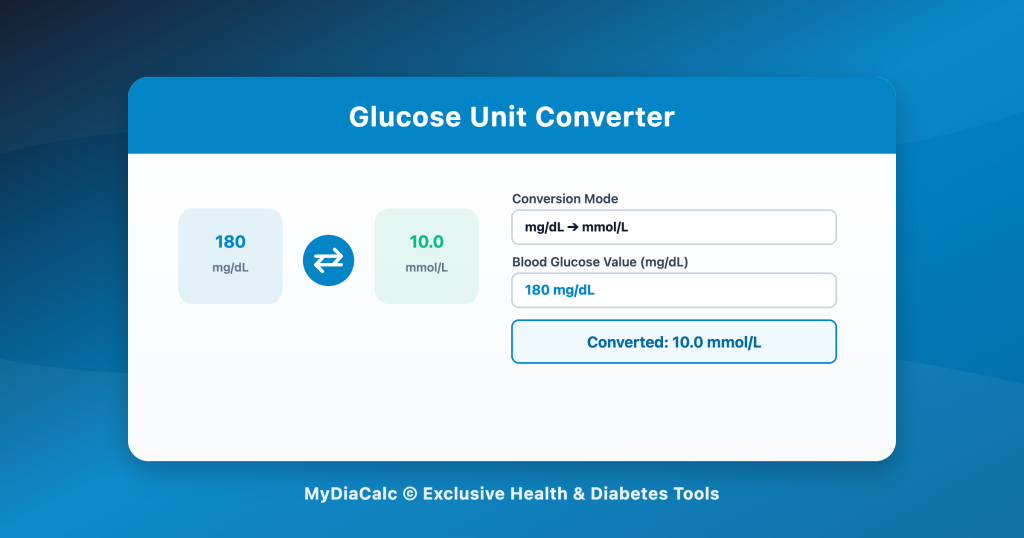
The Glucose Unit Converter provided by MyDiaCalc allows patients, international travelers, and medical professionals to instantly switch between \text{mg/dL} and \text{mmol/L} using exact molecular standards.
🚨 CRITICAL MEDICAL DISCLAIMER & LIMITATION OF LIABILITY (1/3): MyDiaCalc, its owners, operators, and developers ARE NOT RESPONSIBLE OR LIABLE for any medical decisions, dosage adjustments, insulin administration errors, or health complications resulting from the use of this tool or reading this guide. All content, formulas, and results on MyDiaCalc are provided strictly for educational and informational purposes only. They do not constitute professional medical advice, clinical diagnosis, or individualized treatment protocols. Always consult your physician, endocrinologist, or certified diabetes care team regarding blood glucose interpretation.
1. What Is the Molecular Difference Between mg/dL and mmol/L?
To understand why two different units exist, it helps to examine how chemistry defines blood glucose concentrations:
- Milligrams per Deciliter (mg/dL): This is a weight-per-volume concentration measurement. It measures the physical mass of glucose in milligrams present in one deciliter (100\text{ mL}) of blood plasma.
- Millimoles per Liter (mmol/L): This is a molar concentration measurement (SI standard). It measures the molecular count of glucose molecules present in one liter of blood plasma.
Because glucose has a molecular weight (molar mass) of approximately 180.156 grams per mole, converting weight-based measurements to molecular count measurements involves dividing or multiplying by the exact scientific conversion factor of 18.0182.
2. The Conversion Formulas
The mathematical principles utilized by international laboratories and embedded into the MyDiaCalc conversion engine are expressed as:
Converting mg/dL to mmol/L:
\text{Glucose (mmol/L)} = \frac{\text{Glucose (mg/dL)}}{18.0182}
For quick mental math, you can divide the \text{mg/dL} value by 18.
Converting mmol/L to mg/dL:
\text{Glucose (mg/dL)} = \text{Glucose (mmol/L)} \times 18.0182
For quick mental math, you can multiply the \text{mmol/L} value by 18.
🚨 IMPORTANT MEDICAL DISCLAIMER & LIMITATION OF LIABILITY (2/3): We repeatedly stress: MyDiaCalc EXPRESSLY DISCLAIMS ALL LEGAL AND MEDICAL RESPONSIBILITY for any inaccuracies in manual entry, device miscalibrations, or unit confusion. Mistaking \text{mmol/L} for \text{mg/dL} (or vice versa) can lead to severe dosage errors. Always confirm the unit symbol displayed on your glucometer or continuous glucose monitor (CGM).
3. Reference Table: Common Blood Glucose Values Across Units
Below is a quick reference table showing standard glycemic ranges in both international units:
| Clinical State | Glucose in mg/dL | Glucose in mmol/L | Clinical Context |
| Severe Hypoglycemia | 50\text{ mg/dL} | 2.8\text{ mmol/L} | Requires immediate fast-acting carbs |
| Mild Hypoglycemia Threshold | 70\text{ mg/dL} | 3.9\text{ mmol/L} | Standard clinical low blood sugar cutoff |
| Normal Fasting Baseline | 90\text{ mg/dL} | 5.0\text{ mmol/L} | Healthy non-diabetic fasting range |
| Target Fasting (ADA) | 100\text{ mg/dL} | 5.5\text{ mmol/L} | Recommended diabetes fasting upper limit |
| Target Post-Meal (ADA) | 140\text{ mg/dL} | 7.8\text{ mmol/L} | 2 hours post-meal recommended limit |
| Elevated Glucose | 180\text{ mg/dL} | 10.0\text{ mmol/L} | General high blood sugar threshold |
| Significant Hyperglycemia | 250\text{ mg/dL} | 13.9\text{ mmol/L} | Increased risk of ketone accumulation |
| Severe Hyperglycemia | 350\text{ mg/dL} | 19.4\text{ mmol/L} | Medical evaluation required |
4. Practical Travel & Device Setup Scenarios
Scenario A: Traveling Abroad
A person living in the US (\text{mg/dL}) travels to the UK or Europe (\text{mmol/L}) and purchases a local glucometer. The meter reads 9.5 mmol/L.
- Calculation: 9.5 \times 18.0182 = 171.17\text{ mg/dL}.
- Interpretation: Blood sugar is mildly elevated after eating.
Scenario B: Understanding International Clinical Guidelines
An article discusses an average target range of 4.0 to 7.0 mmol/L.
- Calculation Low End: 4.0 \times 18 = 72\text{ mg/dL}.
- Calculation High End: 7.0 \times 18 = 126\text{ mg/dL}.
- Interpretation: The recommended target range corresponds to 72\text{ to }126\text{ mg/dL}.
5. Frequently Asked Questions (FAQ)
Why doesn’t every country use the same blood glucose unit?
Different healthcare systems adopted either the metric mass system (\text{mg/dL}) or the System International molar units (\text{mmol/L}) mid-century. Both systems remain deeply entrenched in their respective medical infrastructures.
Can my glucometer switch between mg/dL and mmol/L?
Some blood glucose meters allow users to change measurement units in settings, but many region-specific glucometers are permanently locked to the local standard to prevent user confusion.
🚨 FINAL MEDICAL DISCLAIMER & LIMITATION OF LIABILITY (3/3): By using MyDiaCalc and its online conversion tools, you explicitly acknowledge and agree that MyDiaCalc and its management hold ZERO LIABILITY OR RESPONSIBILITY for your medical outcomes, dosage choices, or health actions. Always rely on trained medical professionals for clinical guidance.
Content & Calculators Powered by MyDiaCalc © All Rights Reserved.