For decades, the paradigm of diabetes technology was sharply divided. Insulin pumps—medically known as Continuous Subcutaneous Insulin Infusion (CSII) devices—were viewed almost exclusively as the cornerstone of Type 1 Diabetes (T1D) management. Conversely, Type 2 Diabetes Mellitus (T2D) therapy was dominated by oral medications, lifestyle modifications, and, in advanced stages, static Multiple Daily Injections (MDI).
However, a fundamental shift in clinical understanding is occurring. The pathophysiology of Type 2 diabetes is not uniform; many individuals eventually develop profound beta-cell exhaustion or extreme insulin resistance that makes traditional MDI regimens erratic, burdensome, and suboptimal. The answer to the central question—”Can Type 2 Diabetics Wear an Insulin Pump?”—is a definitive yes. Clinical consensus, supported by robust randomized controlled trials (RCTs), now recognizes that CSII can be a highly effective and liberating modality for a specific cohort of insulin-requiring individuals with T2D.
This comprehensive guide, powered by MyDiaCalc, will explore the clinical validity of utilizing insulin pumps for Type 2 diabetes, the specific criteria required to ensure eligibility (and insurance coverage), and the unique metabolic advantages pumps offer this distinct patient population.
🚨 CRITICAL MEDICAL DISCLAIMER & LIMITATION OF LIABILITY (1/3): MyDiaCalc, its developers, authors, and operators DO NOT PROVIDE MEDICAL ADVICE. All information, therapeutic options, diagnostic criteria, and dosing guidelines presented in this article are intended strictly for educational, research, and informational purposes. MyDiaCalc EXPRESSLY DISCLAIMS ALL LIABILITY for any clinical outcomes, self-guided therapeutic adjustments, severe hypoglycemia, or hyperglycemia resulting from the application of concepts discussed herein. Never initiate, stop, or modify insulin therapy or transition to an insulin pump without direct supervision from your board-certified endocrinologist or qualified healthcare provider.
1. Defining the Clinical Rationale: T2D and Insulin Dependency
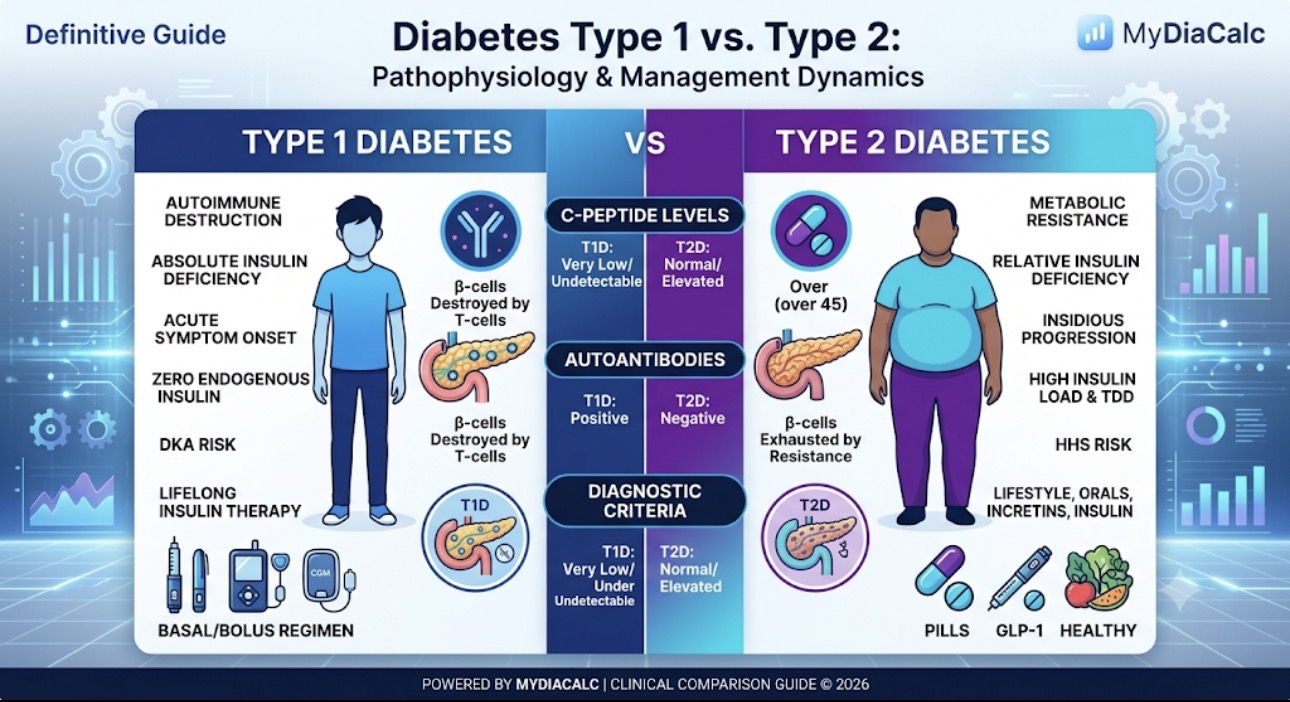
The misconception that insulin pumps are “only for Type 1” stems from a misunderstanding of how Type 2 diabetes evolves. Type 2 is a progressive disease characterized by twin metabolic defects: peripheral insulin resistance (target tissues become less responsive to insulin) and beta-cell secretory defect (the pancreas loses its ability to secrete sufficient insulin).
The Spectrum of Insulin Use in T2D:
- Early Stage: Management focuses on increasing insulin sensitivity (Metformin) or activating incretin pathways (GLP-1 receptor agonists).
- Progression: The pancreatic beta cells “tire out” due to chronic glucotoxicity and lipotoxicity. Endogenous insulin output drops. At this point, basal insulin (long-acting) is typically introduced via MDI.
- Advanced Insulin Dependency: Beta-cell function is virtually absent. The patient now relies entirely on exogenous insulin for both background (basal) stability and mealtime (bolus) coverage. This profile closely resembles T1D from a therapeutic standpoint, making the patient a prime candidate for CSII.
Data at a Glance: Insulin Dosing Burden
| Patient Group | Mean Total Daily Dose (TDD) | Complexity of MDI Regimen | Dosing Precision Needs |
| Type 1 Diabetes | 0.4\text{ to }0.6\text{ units/kg/day} | High (Carb ratios/ISF) | Exceptionally High |
| Type 2 Diabetes (advanced) | \mathbf{0.8\text{ to }2.0+\text{ units/kg/day}} | \mathbf{Moderate\text{ to }High} | High (due to high volume) |
Advanced T2D patients on MDI frequently require over 80\text{ to }150\text{ units} of insulin daily, often delivered as 4 to 6 large-volume injections. Large single boluses are not only painful but also show erratic absorption kinetics, contributing to significant glycemic volatility.
Total Daily Dose & Basal Calculator
2. Who is Eligible? The Clinical Criteria for T2D Pump Candidates
Not every individual with Type 2 diabetes should use an insulin pump. Pump therapy requires a higher degree of device literacy, financial commitment, and adherence to safety protocols (such as site rotation and infusion set maintenance) than MDI. Clinical eligibility centers on patients whose needs exceed what MDI can safely and effectively provide.
+———————————————————————–+
| T2D ELIGIBILITY PROFILE FOR INSULIN PUMPS (CSII) |
+———————————————————————–+
| Criterion | Rationale & Patient Indicators |
+——————————+—————————————–+
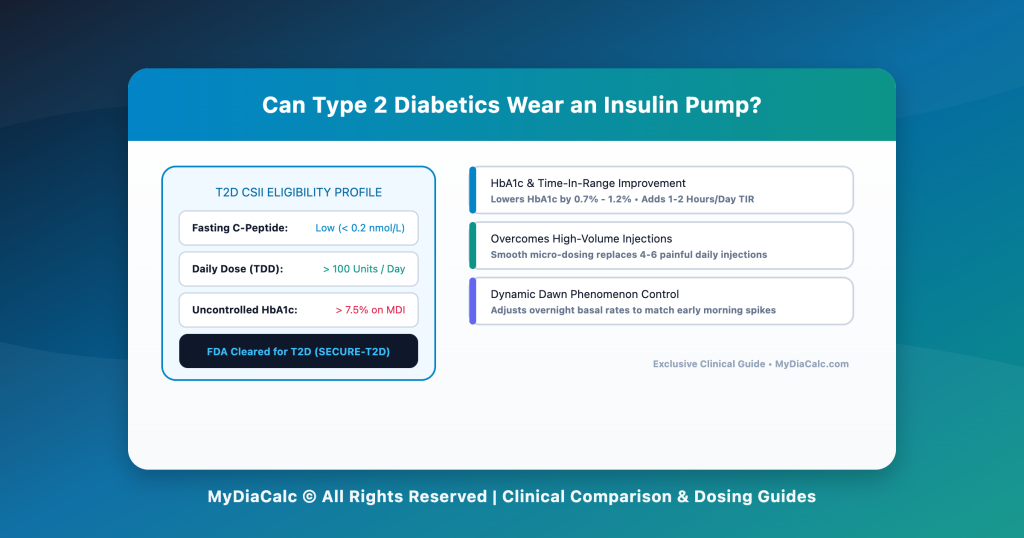
| Uncontrolled HbA1c | Persistently elevated HbA1c ($> 7.5\%\text{–}8.0\%$) despite MDI. |
| Extreme Dosing Complexity | Requirement of $\ge 3$ injections per day (basal + mealtime). |
| Glycemic Variability | Large, unpredictable glucose swings (highs and lows) on MDI. |
| Recurrent Hypoglycemia | Unpredictable low blood glucose events, especially overnight. |
| Severe Insulin Resistance | Total Daily Dose (TDD) $> 100$ units/day (Large vol injections).|
| Injection Fatigue | Psychological burden, skin issues (lipohypertrophy) from pens. |
| Dawn Phenomenon | Marked early-morning hyperglycemia requiring dynamic basal. |
| Commitment to Safety | Willingness to check BG/CGM $\ge 4$x daily and adhere to CSII rules.|
+———————————————————————–+
Proving “Advanced Diabetes” for Insurance Coverage (USA):
Insurance providers (including Medicare) frequently require objective documentation before approving CSII for T2D. This often includes:
- Proof that the patient has been on MDI for at least 6 months.
- Evidence that glycemic targets are not being met (HbA1c > 7.5\text{–}8.0\%).
- C-Peptide Testing: C-peptide is cleaved equimolarly from proinsulin alongside endogenous insulin. In advanced T2D, fasting C-peptide levels should be low (indicating beta-cell failure) to prove absolute insulin requirement. (e.g., C-peptide < 0.2\text{ nmol/L} or below the reference range in some protocols).
3. The Clinical Benefits of CSII Specific to Type 2 Diabetes
RCTs, such as the OPT2MIZE trial, have demonstrated significant metabolic advantages of insulin pumps over MDI in T2D. These benefits are derived not just from automation, but from the fundamental physiology of continuous delivery.
+———————————–+
| T2D Pump Benefits Mechanics |
+———————————–+
|
+———————–+———————–+
| |
v v
+———————–+ +———————–+
| Physiological Basis | | Patient Burden |
| – Mimics basal flow | | – Reduces injections |
| – Reduces vol absorption | | – Dynamic Dawn Phenom |
| – Micro-dosing (0.01) | | – Ease of bolusing |
+———————–+ +———————–+
| | | |
v v v v
+———————–+ +———————–+
| Metabolic Outcomes | | Quality of Life |
| – Lower HbA1c (0.7%↓) | | – Injection Freedom |
| – More TIR (1-2hr↑) | | – Improved nutrition |
| – Reduced Hypo events | | – Meal flexibility |
+———————–+ +———————–+
1. Significant Lowering of HbA1c and Increased Time in Range (TIR)
The primary clinical objective of CSII in T2D is lowering average blood glucose. Clinical data shows that pump therapy in advanced T2D patients typically achieves an HbA1c reduction of 0.5\%\text{ to }1.2\% compared to continuing MDI. Time in Range (TIR, 70\text{–}180\text{ mg/dL}) often increases by 1 to 2 hours per day, predominantly by stabilizing overnight and fasting glucose levels.
2. Eliminating the Large Volume Injection Challenge (LVIC)
For individuals with severe insulin resistance requiring TDD > 100 units, MDI involves delivering large volumes (e.g., 30\text{–}40\text{ units} at once). These large subcutaneous deposits have irregular absorption kinetics, a delayed peak effect, and a longer tail, making postprandial management a guessing game.
- CSII Advantage: Pumps utilize continuous micro-pulses of rapid-acting insulin (delivering as little as 0.01 units) throughout the day. This optimizes absorption and provides a far more predictable insulin-on-board (IOB) curve.
3. Dynamic Management of the Dawn Phenomenon
T2D patients frequently experience a surge of early-morning hepatic glucose output driven by cortisol and growth hormone, leading to severe fasting hyperglycemia.
- MDI Limitation: Static long-acting basal insulins cannot match this dynamic need without risking nighttime hypoglycemia.
- CSII Advantage: Pumps allow different hourly basal rate profiles. A patient can program an increase in delivery (e.g., 2.5\text{ u/hr}) starting at 3:00 AM, matching the liver’s surge and producing stable fasting glucose.
🚨 IMPORTANT MEDICAL DISCLAIMER & LIMITATION OF LIABILITY (2/3): Hypoglycemia Risk with Concentrated Insulins: Advanced T2D often requires high daily doses. Many modern pumps are now compatible with concentrated insulins (e.g., U-200, U-500). MyDiaCalc ASSUMES ZERO LIABILITY for clinical errors, dangerous hypoglycemia, or death resulting from improper configuration of insulin concentration settings or reservoir volumes.
4. Device Selection Strategies for Type 2 Diabetes
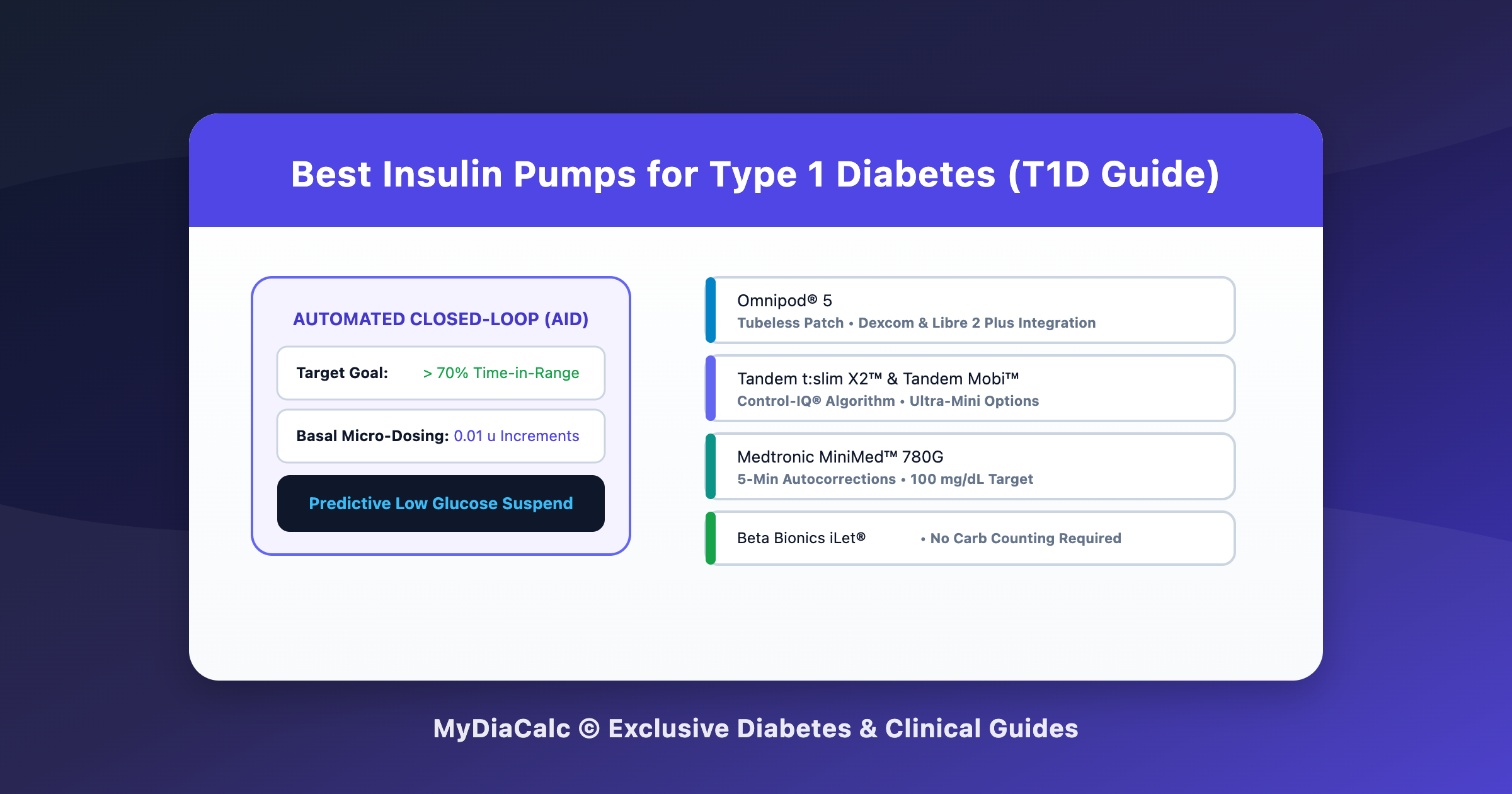
Choosing the right insulin pump for a Type 2 diabetes patient involves evaluating distinct priorities compared to Type 1 diabetes. Key factors include reservoir capacity, form factor (tubed vs. tubeless), and ease of use.
+———————————————————————–+
| PUMP SELECTION MATRIX FOR TYPE 2 DIABETES |
+———————————————————————–+
| Device Model | Type | Reservoir | Key Clinical Advantage |
+——————-+———–+———–+—————————-+
| Insulet Omnipod 5 | Tubeless | 200 Units | Fully tubeless; broad T2D |
| | | | FDA clearance; easy to wear|
| Tandem t:slim X2 | Tubed | 300 Units | High capacity; Control-IQ |
| | | | automated closed-loop |
| Medtronic 780G | Tubed | 300 Units | Aggressive autocorrection; |
| | | | high volume suitability |
| CeQur Simplicity | Mechanical| 200 Units | Non-digital patch; click |
| | Patch | | bolus without app/tubing |
+———————————————————————–+
A. Tubeless Patch Pumps (e.g., Omnipod 5)
- Why T2D Patients Prefer It: Eliminates tubing completely, reducing the fear of snags. The Pod adheres directly to the skin and delivers continuous automated insulin guided by integrated Continuous Glucose Monitor (CGM) readings.
- Limitations: The 200-unit reservoir may require Pod changes every 2 days (rather than 3) for patients with total daily doses exceeding 100 units.
B. High-Capacity Tubed Pumps (e.g., Tandem t:slim X2, Medtronic 780G)
- Why T2D Patients Prefer It: A 300-unit cartridge/reservoir allows patients with high insulin resistance to maintain a full 3-day set wear schedule without premature reservoir exhaustion.
- Algorithmic Edge: Systems like the Medtronic 780G deliver automatic correction boluses as often as every 5 minutes, significantly mitigating postprandial spikes from uncounted or under-bolused meals.
5. Dosing Dynamics and MDI-to-Pump Conversion Protocol
Transitioning a Type 2 patient from Multiple Daily Injections (MDI) to Continuous Subcutaneous Insulin Infusion (CSII) requires careful clinical recalibration to avoid acute hypoglycemia or sustained hyperglycemia.
+———————————————————————–+
| MDI TO PUMP CONVERSION STEP-BY-STEP |
+———————————————————————–+
| 1. Calculate Current TDD: Sum all basal + bolus units on MDI. |
| 2. Apply Total Reduction: Reduce total TDD by 10% to 20%. |
| 3. Split Basal/Bolus Ratio: Assign 50% to Basal and 50% to Bolus. |
| 4. Program Basal Rates: Divide daily basal dose by 24 hours. |
| 5. Establish ICR & ISF: Program conservative starting ratios. |
+———————————————————————–+
Standard Calculation Formula:
- Total Daily Dose (TDD) Assessment: \text{MDI TDD} = \text{Daily Basal Units} + \text{Total Daily Prandial Units}
- Initial Pump TDD (15% Reduction Factor): Because CSII delivery provides higher bioavailability and more consistent subcutaneous absorption, reduce MDI TDD by 10\%\text{ to }20\%: \text{Pump TDD} = \text{MDI TDD} \times 0.85
- Basal Rate Allocation (50% of Pump TDD): \text{Hourly Basal Rate} = \frac{\text{Pump TDD} \times 0.50}{24}
Clinical Example:
A patient taking 60 units of Glargine (basal) plus 20 units of Lyspro before 3 meals (60 units bolus) has an \text{MDI TDD} = 120\text{ units}.
- \text{Pump TDD} = 120 \times 0.85 = \mathbf{102\text{ units/day}}
- \text{Daily Basal Portion (50\%)} = 51\text{ units}
- \text{Initial Hourly Basal Rate} = \frac{51}{24} = \mathbf{2.125\text{ units/hour}}
6. Overcoming Barriers to Adoption in Type 2 Diabetes
Despite clear clinical benefits, barriers to widespread insulin pump adoption in T2D persist:
- Perceived Complexity: Patients may fear that pumps require complex programming. Modern Automated Insulin Delivery (AID) systems and simplified mechanical patches (like CeQur Simplicity) significantly reduce user burden.
- Insurance Documentation: Primary care providers often struggle with insurance paperwork. Utilizing standardized C-peptide testing, CGM logs showing glycemic variability, and documentation of MDI adherence streamlines the authorization process.
- Skin Integrity: High volume delivery at a single infusion site can lead to lipohypertrophy. Educating patients on structured site rotation (abdomen, upper buttocks, thighs) is critical for consistent absorption.
Conclusion: Expanding Technological Equity in T2D
The clinical evidence is clear: Type 2 diabetics who require intensive insulin therapy can and should be considered for insulin pump therapy. Continuous Subcutaneous Insulin Infusion bridges the gap between high metabolic demand and daily glycemic control, delivering micro-dosing precision, eliminating injection fatigue, and significantly lowering HbA1c while improving Time in Range.
Through appropriate candidate selection, careful dosing conversion, and modern automated closed-loop technology, CSII empowers individuals with advanced Type 2 diabetes to achieve glycemic autonomy and long-term metabolic health.
🚨 FINAL MEDICAL DISCLAIMER & LIMITATION OF LIABILITY (3/3): By utilizing MyDiaCalc, its calculators, tools, comparison charts, and educational guides, you explicitly acknowledge and agree that all therapeutic health decisions, glycemic interpretations, device selection choices, and clinical management decisions remain exclusively your personal responsibility or the responsibility of your licensed healthcare provider. MyDiaCalc, its authoring team, development staff, and affiliated entities SHALL NOT BE HELD LIABLE for any direct, indirect, incidental, consequential, or punitive damages resulting from the application or misuse of any calculations, guidelines, diagnostic benchmarks, or clinical concepts presented herein. Always work directly with your licensed endocrinologist or certified diabetes care specialist to establish safe individual treatment protocols.
Powered by MyDiaCalc © All Rights Reserved.