Continuous Subcutaneous Insulin Infusion (CSII) via advanced insulin pumps has revolutionized the management of Type 1 Diabetes Mellitus (T1D). Moving away from traditional Multiple Daily Injections (MDI), modern insulin pumps offer unprecedented precision, automated basal adjustments, and continuous communication with Continuous Glucose Monitors (CGMs).
Choosing the best insulin pump for Type 1 diabetes involves evaluating complex criteria, including automated insulin delivery (AID) algorithms, tubed vs. tubeless form factors, target glucose adaptability, and sensor integration flexibility.
🚨 CRITICAL MEDICAL DISCLAIMER & LIMITATION OF LIABILITY (1/3): MyDiaCalc, its developers, authors, and operators DO NOT PROVIDE MEDICAL ADVICE. All information, clinical concepts, device comparisons, and dosing guidelines presented in this article are intended strictly for educational, research, and informational purposes. MyDiaCalc EXPRESSLY DISCLAIMS ALL LIABILITY for any clinical decisions, pump setting adjustments, severe hypoglycemia, or diabetic ketoacidosis (DKA) resulting from self-guided therapy changes. Always consult your endocrinologist, certified diabetes care and education specialist (CDCES), or qualified healthcare provider before transitioning to or modifying insulin pump therapy.
1. The Paradigm Shift: Why Transition to an Insulin Pump in T1D?
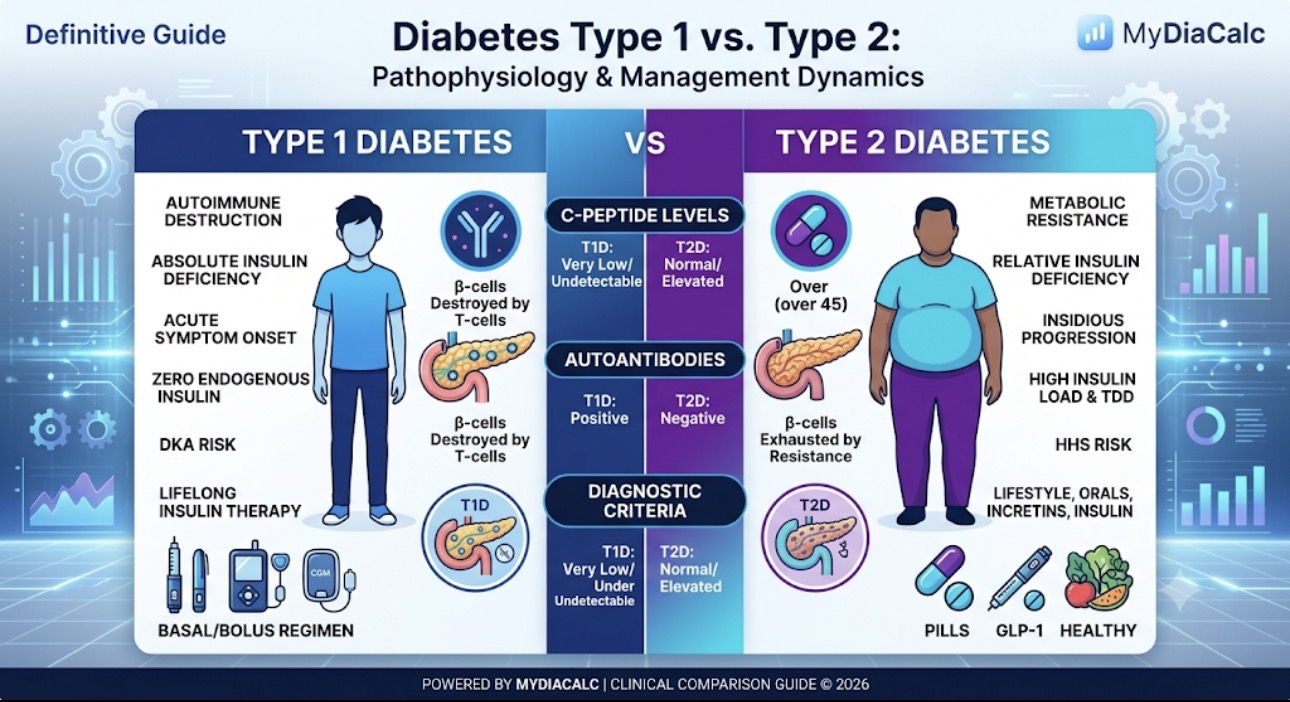
In Type 1 diabetes, the autoimmune destruction of pancreatic beta cells leaves the body entirely dependent on exogenous insulin. While MDI regimens (using long-acting basal and rapid-acting bolus insulins) can sustain life, achieving tight glycemic targets without suffering from frequent hypoglycemia remains exceptionally difficult.
+———————————————————————–+
| ADVANTAGES OF PUMP THERAPY OVER MDI IN T1D |
+———————————————————————–+
| Feature | Multiple Daily Injections | Insulin Pump |
+————————-+—————————+—————–+
| Delivery Precision | Half-unit or full-unit | 0.01 to 0.025 u |
| Basal Customization | Flat 24-hour rate | Hourly profiles |
| Hypoglycemia Protection | Reactive (eat carbs) | Predictive Auto-Stop|
| Micro-Dosing | High risk of stacking | Automated AID |
+———————————————————————–+
Key Clinical Drivers for CSII in Type 1 Diabetes:
- Micro-Dosing Precision: Insulin pumps deliver rapid-acting insulin in tiny, continuous fractions (down to 0.01 units), mimicking physiological pancreatic basal output.
- Dynamic Basal Profiles: T1D patients frequently experience shifting circadian insulin sensitivity, such as the Dawn Phenomenon (early morning glucose rise driven by cortisol and growth hormone) or increased sensitivity during nighttime sleep. Pumps allow multiple basal rate profiles throughout a 24-hour cycle.
- Automated Closed-Loop Systems (Artificial Pancreas): Modern pumps integrate directly with real-time CGM data, continuously calculating and adjusting basal delivery every 5 minutes to prevent both hyperglycemia and hypoglycemia.
2. Key Device Evaluation Criteria for T1D
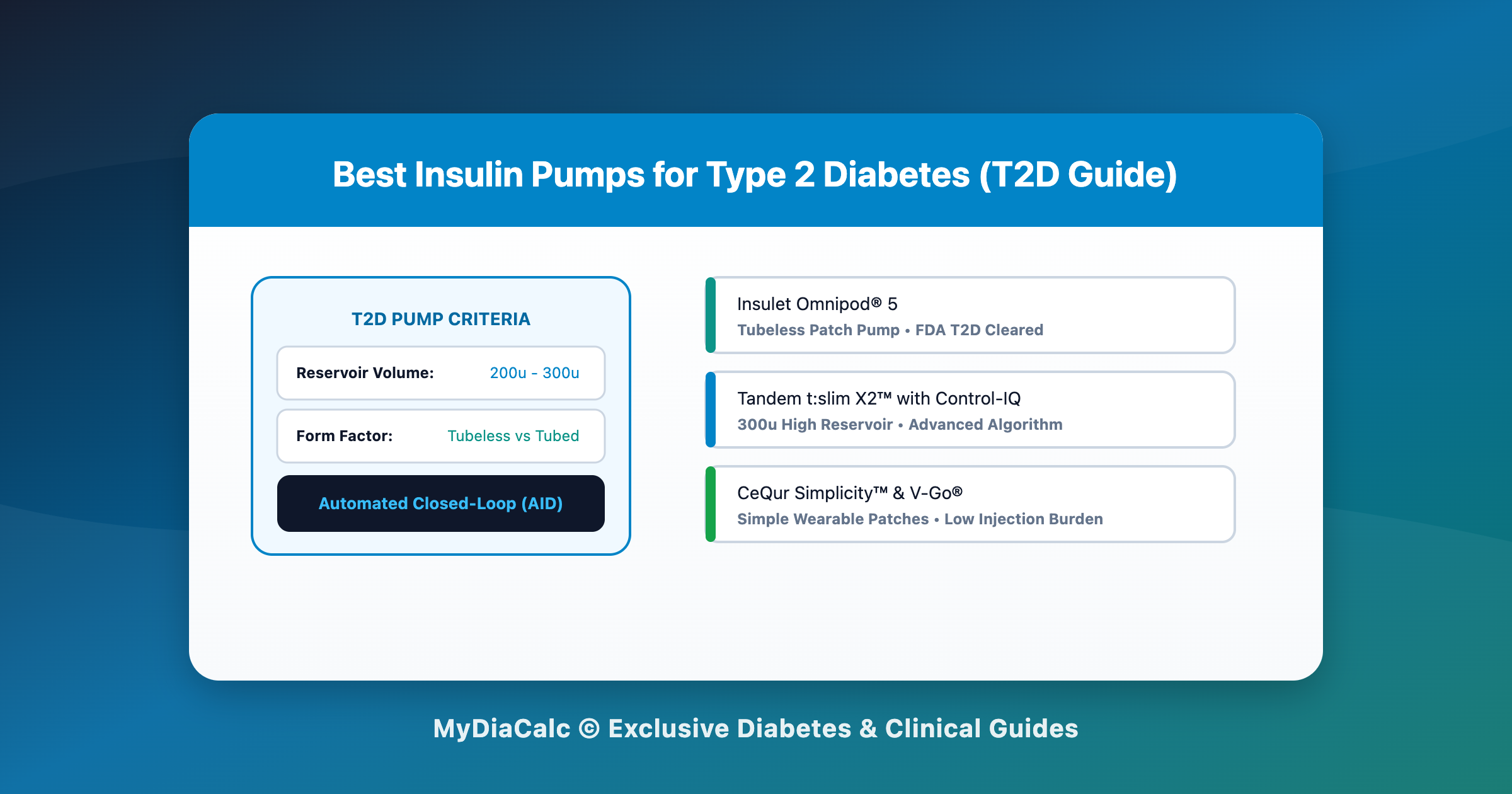
When evaluating the market to determine the top insulin pump for an individual living with Type 1 diabetes, clinical specialists examine four primary technical metrics:
+———————————–+
| T1D Pump Evaluation Pillars |
+———————————–+
|
+—————–+————+————+—————–+
| | | |
v v v v
+———-+ +———–+ +———–+ +———–+
| Algorithm| | Form | | Sensor | | Target |
| Type | | Factor | | Ecosystem | | Flexibility|
| (AID/PID)| | (Tubed/Pod| | (Dexcom/ | | (100-120 |
| | | | | Libre/G4) | | mg/dL) |
+———-+ +———–+ +———–+ +———–+
A. Form Factor: Tubed vs. Tubeless (Patch)
- Tubed Pumps: Feature a durable housing (containing the motor, battery, and reservoir) connected to a subcutaneous cannula via plastic tubing. Tubed pumps typically offer higher reservoir capacities (up to 300 units) and physical display screens.
- Tubeless (Patch) Pumps: Adhere directly to the skin, housing both the reservoir and insertion cannula in a single disposable unit (“Pod”). They are operated wirelessly via a dedicated controller or smartphone app, eliminating snag hazards during sports, swimming, and sleep.
B. Algorithm Aggressiveness and Correction Targets
Closed-loop algorithms use predictive mathematical models to forecast blood glucose levels 30 to 60 minutes into the future:
- Fixed Targets: Some algorithms maintain a non-adjustable target (e.g., 112.5\text{ mg/dL} or 120\text{ mg/dL}).
- Adjustable Targets: Advanced algorithms allow tight target setting down to 100\text{ mg/dL}, highly advantageous for patients aiming for optimal HbA1c (< 6.5\%) without increasing hypoglycemia risk.
3. Top Insulin Pumps for Type 1 Diabetes: Clinical Analysis
Below is an extensive clinical comparison of the leading FDA-cleared insulin pumps designed for adults and children with Type 1 diabetes.
+———————————————————————–+
| LEADING INSULIN PUMPS FOR TYPE 1 DIABETES |
+———————————————————————–+
| System Name | Type | CGM Compatibility | Max Reservoir |
+———————+———–+——————–+—————-+
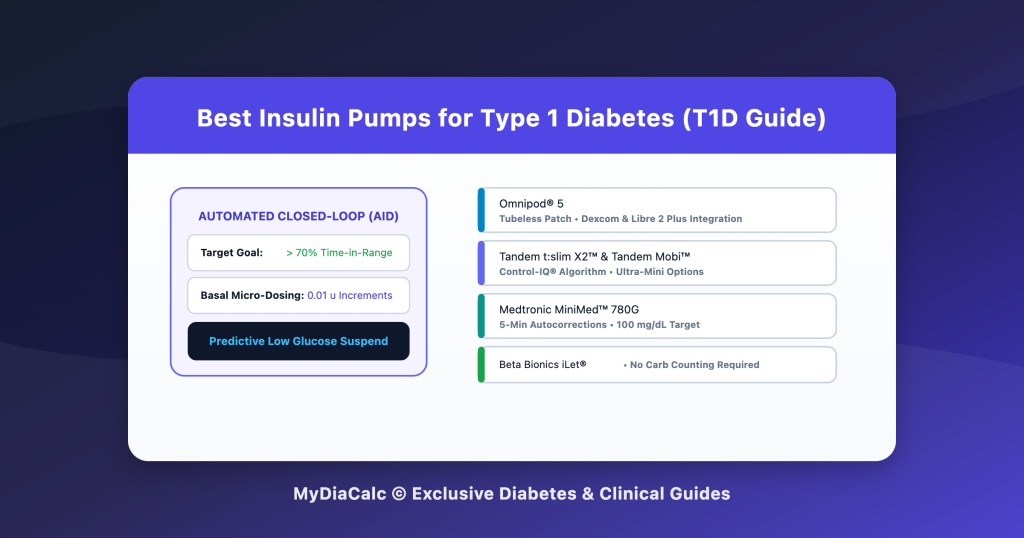
| Insulet Omnipod 5 | Tubeless | Dexcom G6/G7, | 200 Units |
| | | Libre 2 Plus | |
| Tandem t:slim X2 | Tubed | Dexcom G6/G7, | 300 Units |
| (Control-IQ) | | Libre 2 Plus | |
| Tandem Mobi | Ultra-Mini| Dexcom G6/G7 | 200 Units |
| Medtronic 780G | Tubed | Guardian 4 / Simpli| 300 Units |
| Beta Bionics iLet | Tubed | Dexcom G6/G7 | 160 Units |
+———————————————————————–+
1. Insulet Omnipod 5 (Best Tubeless Automated System)
The Omnipod 5 remains a market leader for T1D due to its completely tubeless, waterproof patch design and seamless automated integration.
- Key Clinical Strengths:
- On-Body Intelligence: The SmartAdjust technology algorithm resides directly inside the Pod itself, meaning automated insulin adjustments continue even if the smartphone controller is lost or out of range.
- Multiple Target Levels: Offers customizable target glucose levels (110, 120, 130, \text{ or } 140\text{ mg/dL}), accommodating different clinical needs (e.g., pregnancy vs. physical activity).
- Multi-Sensor Interoperability: Broad compatibility with both Dexcom (G6/G7) and Abbott FreeStyle Libre 2 Plus sensors.
2. Tandem t:slim X2 with Control-IQ (Best for Target Precision & Customization)
The t:slim X2 is a proven workhorse in T1D management, known for its intuitive color touchscreen and robust closed-loop algorithm.
- Key Clinical Strengths:
- Control-IQ Technology: Predicts sensor values 30 minutes in advance and automatically adjusts basal rates, delivers automated correction boluses (up to 1 per hour), and pauses delivery during predicted lows.
- High Capacity (300 Units): Excellent for T1D patients with higher basal requirements or those utilizing longer wear protocols.
- Software Updatability: Pump firmware can be updated remotely via computer, eliminating the need to buy new hardware when new features are released.
Insulin to Carb Meal Calculator
🚨 IMPORTANT MEDICAL DISCLAIMER & LIMITATION OF LIABILITY (2/3): Sensor Accuracy & Algorithmic Failure: Automated Insulin Delivery (AID) systems rely entirely on continuous glucose sensor accuracy. Sensor errors, compression lows, or site occlusion can lead to inappropriate insulin dosing. MyDiaCalc ASSUMES ZERO LIABILITY for clinical outcomes, ketoacidosis, or severe hypoglycemia associated with automated pump algorithms.
3. Comprehensive Evaluation of the Best T1D Pumps (Continued)
3. Tandem Mobi (Best Ultra-Compact Tubed Hybrid)
The Tandem Mobi is currently the smallest automated insulin delivery system available, designed for maximum discretion without sacrificing tubed-pump capacity.
- Key Clinical Strengths:
- Ultra-Small Form Factor: Half the size of the t:slim X2, easily fitting into a coin pocket or clipped to clothing.
- Flexible Tubing Options: Can be worn with short 5-inch tubing to act almost like a patch pump, or standard tubing lengths.
- Full Control-IQ Integration: Powered by the same proven Control-IQ algorithm as the t:slim X2, fully operated via iPhone app with an physical quick-bolus button on the device.
4. Medtronic MiniMed 780G (Best for Meal-Time Forgiveness & High Autonomy)
The Medtronic MiniMed 780G with SmartGuard technology is engineered to minimize the burden of precise carbohydrate counting.
- Key Clinical Strengths:
- Autocorrection Delivery Every 5 Minutes: If glucose spikes due to unannounced meals or delayed boluses, the algorithm aggressively delivers autocorrection doses continuously to bring glucose back to target.
- Low Target Option (100 mg/dL): Allows a safe target setting of 100\text{ mg/dL}, enabling users to achieve higher Time-in-Range (TIR) metrics above 80\%.
- Simpli strata / Guardian 4 Sensor: No-fingerstick calibration sensors paired directly with the system.
5. Beta Bionics iLet Bionic Pancreas (Best for Simplified Management)
The iLet Bionic Pancreas takes automation to the extreme by eliminating conventional carb counting, basal rates, and correction factors entirely.
- Key Clinical Strengths:
- Zero Carb Counting: Users do not enter carb grams; they simply announce meal size (e.g., “Usual,” “More,” or “Less” for Breakfast/Lunch/Dinner).
- Fully Autonomous Initialization: Requires only the patient’s body weight to initiate therapy, continuously learning and adapting to metabolic changes automatically.
4. Advanced Clinical Metrics: Evaluating AID Performance
When comparing these systems for Type 1 diabetes, clinical endocrinologists evaluate three primary outcome metrics defined by the International Consensus on Time in Range:
+———————————————————————–+
| INTERNATIONAL TIME-IN-RANGE TARGETS |
+———————————————————————–+
| Metric | Target Goal (T1D Standard) |
+—————————–+—————————————–+
| Time in Range (70-180 mg/dL)| > 70% of the day (~16.8 hours) |
| Time Below Range (<70 mg/dL)| < 4% of the day (~57 minutes) |
| Severe Lows (<54 mg/dL) | < 1% of the day (~14 minutes) |
| Time Above Range (>180 mg/d)| < 25% of the day |
+———————————————————————–+
The Role of AID in Achieving >70% TIR:
Clinical trials consistently show that transitioning from MDI to advanced hybrid closed-loop (AHCL) systems increases Time-in-Range by 11% to 15% on average—equivalent to gaining an additional 2.5 to 3.6 hours per day in ideal glucose ranges while simultaneously reducing nocturnal hypoglycemia to near-zero levels.
5. Dosing Parameters and Pump Setup in T1D
Configuring an insulin pump for Type 1 diabetes requires precise setting of four core mathematical variables:
+———————————————————————–+
| PUMP PROGRAMMING PARAMETERS |
+———————————————————————–+
| 1. Basal Rates (u/hr) | Delivers continuous background insulin. |
| 2. ICR (g/unit) | Grams of carbohydrate covered by 1u. |
| 3. ISF / Correction Factor | Blood glucose drop (mg/dL) per 1u. |
| 4. Active Insulin Time (DIA)| Duration of insulin action (3 to 5 hrs).|
+———————————————————————–+
Formula Quick-Reference:
- Total Daily Dose (TDD) Estimation: \text{TDD (units)} = \text{Weight in kg} \times 0.55
- Basal Allocation (50% of TDD): \text{Hourly Basal} = \frac{\text{TDD} \times 0.50}{24}
- Rule of 500 (Carbohydrate Ratio – ICR): \text{ICR} = \frac{500}{\text{TDD}}
- Rule of 1800 (Insulin Sensitivity Factor – ISF): \text{ISF} = \frac{1800}{\text{TDD}}
Total Daily Dose & Basal Calculator
6. T1D Decision Matrix: Selecting Your Best Fit
| Individual Priority / Need | Recommended System Class | Top Recommended Device |
| Water Sports, Active Lifestyle, No Tubing | Tubeless Wearable Patch Pump | Insulet Omnipod 5 |
| Tightest Target Setting (100\text{ mg/dL} Target) | Advanced Closed-Loop Tubed Pump | Medtronic MiniMed 780G |
| Maximum Discretion & Compact Size | Ultra-Miniature Smart Pump | Tandem Mobi |
| Software Updates & Customizable Profiles | High-Capacity Touchscreen Pump | Tandem t:slim X2 |
| Desire to Avoid Carbohydrate Counting | Fully Autonomous Bionic System | Beta Bionics iLet |
🚨 FINAL MEDICAL DISCLAIMER & LIMITATION OF LIABILITY (3/3): By utilizing MyDiaCalc, its calculators, tools, and educational guides, you explicitly acknowledge and agree that all therapeutic health decisions, insulin adjustments, and device selection choices remain exclusively your personal responsibility. MyDiaCalc, its authoring team, development staff, and affiliated entities SHALL NOT BE HELD LIABLE for any direct, indirect, incidental, consequential, or punitive damages resulting from the application or misuse of any calculations, guidelines, or technological evaluations presented herein. Always work directly with your licensed endocrinologist or certified diabetes care specialist to establish safe individual treatment protocols.
Powered by MyDiaCalc © All Rights Reserved.