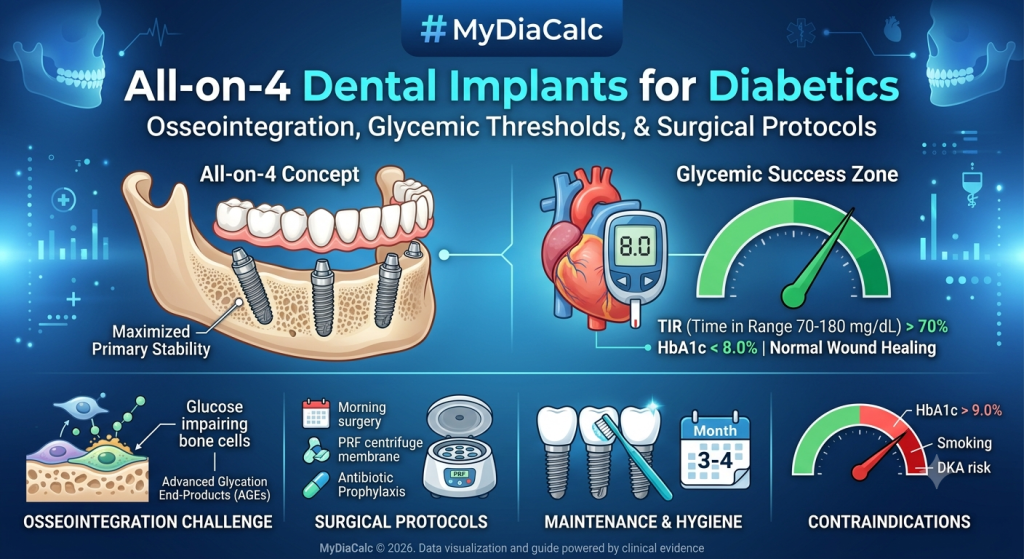
Full-mouth rehabilitation using All-on-4 dental implants has transformed restorative dentistry, offering patients with severe edentulism or failing dentition an immediate, fixed prosthesis supported by four strategically angled implants. However, when evaluating candidates who also live with diabetes mellitus—whether Type 1 or Type 2—clinicians and patients face a distinct set of biological and surgical challenges.
Historically, diabetes was considered a relative or even absolute contraindication for implant placement due to fears of poor wound healing, microvascular impairment, higher infection susceptibility, and compromised osseointegration (the biological fusion between bone and titanium). Today, advancements in continuous glucose monitoring (CGM), localized surgical protocols, biomaterials, and strict glycemic control metrics have made All-on-4 full-arch restoration a highly predictable option for diabetic patients.
🚨 CRITICAL MEDICAL DISCLAIMER & LIMITATION OF LIABILITY (1/3): MyDiaCalc, its developers, authors, and operators DO NOT PROVIDE MEDICAL OR DENTAL ADVICE. All information, surgical benchmarks, glycemic thresholds, and pharmacological protocols presented in this guide are intended strictly for educational, research, and informational purposes. MyDiaCalc EXPRESSLY DISCLAIMS ALL LIABILITY for any surgical outcomes, implant failures, peri-implantitis, severe hypoglycemia, or delayed wound healing resulting from self-guided decisions. Always consult a licensed oral surgeon, periodontist, and endocrinologist prior to undergoing implant surgery.
1. Biological Foundations: How Diabetes Affects Osseointegration
To understand why All-on-4 therapy requires specialized care in diabetic patients, one must examine the cellular mechanisms that govern bone healing and soft tissue repair around titanium implants.
+———————————————————————–+
| GLYCEMIC IMPACT ON OSSEOINTEGRATION |
+———————————————————————–+
| UNCONTROLLED HYPERGLYCEMIA |
| ├── Accumulation of Advanced Glycation End-Products (AGEs) |
| ├── Impaired Osteoblast Differentiation & Collagen Cross-linking |
| ├── Accelerated Osteoclast Activity (Bone Resorption) |
| └── Microvascular Ischemia & Microvascular Wall Thickening |
| |
| RESULT: Delayed Primary Stability & Elevated Risk of Early Failure |
+———————————————————————–+
A. Advanced Glycation End-Products (AGEs) and Bone Quality
Persistent systemic hyperglycemia leads to the non-enzymatic glycation of proteins, forming Advanced Glycation End-Products (AGEs).
- Bone Matrix Alteration: AGEs accumulate within the extracellular matrix of alveolar bone, cross-linking with type I collagen. This diminishes the structural integrity and flexibility of the jawbone.
- Impaired Osteoblasts: AGE interaction with its cell receptor (RAGE) inhibits osteoblast proliferation, maturation, and extracellular matrix deposition, delaying the initial bone-to-implant contact (BIC) crucial for All-on-4 stability.
B. Microvascular Integrity and Wound Healing
Periodontal healing relies heavily on rapid angiogenesis—the formation of new capillary blood vessels—and efficient recruitment of immunocompetent cells. Diabetes induces microvascular basement membrane thickening, reducing localized tissue perfusion, blunting macrophage efficiency, and impairing early clot stabilization following surgical implant bed preparation.
Insulin to Carb Meal Calculator
2. Glycemic Benchmarks and Pre-Operative Assessment
Predictable All-on-4 outcomes in diabetic individuals hinge on precise pre-operative risk stratification based on objective glycemic markers rather than diagnosis duration alone.
+———————————————————————–+
| GLYCEMIC RISK STRATIFICATION MATRIX |
+———————————————————————–+
| Category | HbA1c Range | Mean Glucose | All-on-4 Eligibility |
+——————+————–+—————+———————-+
| Well-Controlled | < 7.0% | < 154 mg/dL | Optimal Candidate |
| Moderate Control | 7.0% – 8.0% | 154-183 mg/dL | Eligible with Protocol|
| Elevated Risk | 8.1% – 9.0% | 184-212 mg/dL | Pre-op Optimization |
| Uncontrolled | > 9.0% | > 212 mg/dL | Contraindicated |
+——————+————–+—————+———————-+
A. Glycated Hemoglobin (HbA1c) Thresholds
- HbA1c < 7.5\%: Clinical literature demonstrates implant survival rates in this group (often exceeding 96\%\text{ to }98\%) that are virtually identical to non-diabetic controls.
- HbA1c 7.5\%\text{ to }8.5\%: Implant surgery remains highly viable, but surgeons often modify protocols—such as extending non-loading healing periods or using rough-surface implants treated with bioactive coatings (e.g., hydroxyapatite or fluoride-modified titanium).
- HbA1c > 9.0\%: Surgical intervention should be postponed until glycemic control is stabilized. The risk of early implant loss, surgical site infection, and flap necrosis increases exponentially in this tier.
B. Time in Range (TIR) and Peri-Operative Stability
While HbA1c reflects a 3-month average, Time in Range (TIR) obtained via Continuous Glucose Monitoring (CGM) provides a real-time assessment of glycemic volatility:
- Target a TIR (70\text{–}180\text{ mg/dL}) of > 70\% for at least 2 to 4 weeks prior to full-arch surgery to minimize post-operative inflammatory surges.
3. The All-on-4 Concept: Structural Advantages for Diabetics
The All-on-4 treatment concept—pioneered by Dr. Paulo Malo—utilizes four implants in an edentulous arch: two anterior implants placed vertically and two posterior implants tilted angled up to 45^\circ. This specific configuration offers unique clinical benefits for diabetic patients with compromised bone density.
+———————————–+
| All-on-4 Biomechanical Advantages|
+———————————–+
|
+———————–+———————–+
| |
v v
+———————–+ +———————–+
| Cortical Bone Focus | | Avoids Bone Grafting |
| – Angled posterior | | – Reduces surgical |
| implants engage | | morbidity & failure |
| dense cortical bone| | risk of bone grafts |
+———————–+ +———————–+
Key Biomechanical Advantages for Diabetic Candidates:
- Bypassing Sinus & Nerve Augmentation: Diabetic patients often experience compromised bone grafting outcomes due to impaired revascularization of particulate bone grafts. By tilting posterior implants, surgeons can utilize existing native bone and avoid complex sinus floor elevations or block grafts.
- Engagement of Dense Cortical Bone: Tilting the posterior implants allows them to be anchored into the high-density cortical bone of the anterior sinus wall or mental foramen, ensuring high Primary Insertion Torque (\ge 35\text{–}45\text{ Ncm}), which is essential for immediate provisional prosthetic loading.
- Reduced Surgical Footprint: Placing 4 implants rather than 8 to 10 individual implants reduces total flap reflections, surgical duration, and localized trauma, leading to faster tissue re-epithelialization.
🚨 IMPORTANT MEDICAL DISCLAIMER & LIMITATION OF LIABILITY (2/3): Hypoglycemia During Surgery: Prolonged oral surgery under local anesthesia, sedation, or general anesthesia alters normal dietary patterns. Diabetic patients face heightened risks of intra-operative or post-operative hypoglycemia. MyDiaCalc ASSUMES ZERO LIABILITY for clinical complications, emergency hospitalizations, or metabolic crises associated with dental surgical procedures.
4. Peri-Operative Surgical and Pharmacological Protocols
Predictable All-on-4 dental implant outcomes in diabetic candidates are rarely achieved by chance; they are the result of adhering to established clinical protocols that minimize surgical stress and maximize biological responses.
+———————————————————————–+
| THE DIABETIC ALL-ON-4 SURGICAL CHECKLIST |
+———————————————————————–+
| PRE-OPERATIVE PROTOCOL |
| ├── HbA1c < 8.0% and Blood Glucose < 180 mg/dL |
| ├── Morning appointment (minimize NPO period) |
| ├── Prophylactic Antibiotics (e.g., 2g Amoxicillin 1hr pre-op) |
| └── Glucose monitoring immediately before first incision |
| |
| INTRA-OPERATIVE PROTOCOL |
| ├── Minimally invasive flap design or flapless approach |
| ├── Continuous monitoring with CGM or fingersticks |
| └── Maintain intra-op BG target: 120-160 mg/dL |
+———————————————————————–+
A. Morning Surgery Timing
All-on-4 surgery should ideally be scheduled for early morning. This minimizes the duration of the “Nil Per Os” (NPO – nothing by mouth) fasting period required if intravenous sedation is utilized, reducing the risk of pre-operative hypoglycemia associated with basal insulin use.
B. Prophylactic Antibiotic Coverage
Systemic diabetes impairs localized immune responses. To counteract heightened bacterial colonization risk during full-arch reflection, antibiotic prophylaxis—typically a single loading dose of Amoxicillin (or Clindamycin for allergic patients)—must be administered one hour prior to surgery.
C. Surgical Site Management: Platelet-Rich Fibrin (PRF)
A highly effective adjunctive strategy is the use of autologous Platelet-Rich Fibrin (PRF) or Platelet-Rich Plasma (PRP), obtained by centrifuging the patient’s own blood:
- Mechanism: The surgeon applies PRF membranes over the implant sites prior to flap suturing. PRF is rich in bioactive growth factors (TGF-\beta, PDGF, IGF) that accelerate soft tissue angiogenesis and early-stage osteogenesis, effectively counteracting the diabetic cellular lag.
5. Long-Term Maintenance and Peri-Implant Dynamics
While osseointegration is the first biological checkpoint, long-term All-on-4 success in diabetics requires perpetual vigilance against peri-implant disease.
+———————————————————————–+
| THE INFLAMMATORY CASCADE IN DIABETES |
+———————————————————————–+
| UNCONTROLLED GLYCEMIA (HbA1c > 8.0%) |
| ├── Persistent AGEs / RAGE interaction |
| ├── Sustained Pro-Inflammatory State (↑ TNF-α, ↑ IL-1β) |
| ├── Compromised Neutrophil Function |
| └── Impaired Microvascular Circulation around Implants |
| |
| RESULT: Exponentially ↑ Risk of Peri-Implantitis & Late Failure |
+———————————————————————–+
A. Peri-Implantitis and Sustained Hyperglycemia
Peri-implantitis—the inflammatory destruction of bone supporting an implant—occurs with greater frequency and severity in individuals with poorly controlled diabetes.
- The Mechanism: High systemic glucose acts as a continuous fuel source for pathogenic periodontal bacteria (e.g., P. gingivalis) around the implants. Simultaneous microvascular impairment blunts the body’s ability to deliver immune cells, leading to rapid, painless bone loss around the angled All-on-4 fixtures.
B. Proactive Recall Protocols (3-4 Month Cycles)
Non-diabetic full-arch implant patients may adhere to 6-month recall schedules. For diabetic patients, a strict 3-to-4 month professional maintenance schedule is imperative:
- The Clinical Focus: These appointments focus on professional plaque debridement around the final All-on-4 prosthesis and sub-prosthetic hygiene inspection, alongside verification of stable HbA1c levels.
6. Contraindications and Critical Risk Factors
While All-on-4 therapy is largely safe, certain comorbid scenarios pose unacceptable risks for implant failure in diabetic candidates.
Absolute Surgical Contraindications:
- Uncontrolled Hyperglycemia: An HbA1c persistently > 10.0\%.
- Acute Metabolic State: Recent history (within 6 months) of Diabetic Ketoacidosis (DKA) or Hyperosmolar Hyperglycemic State (HHS).
- Severe Renal Impairment: End-stage renal disease (ESRD) or patients on active dialysis, which causes severe mineral and bone metabolism defects (renal osteodystrophy).
Elevated Risk Modifiers (Surgical Caution):
- Smoking / Tobacco Use: Smoking combined with diabetes creates a profound synergistic risk, creating severe localized vasoconstriction and blunting wound healing; many surgeons require mandatory tobacco cessation before full-arch therapy.
- History of Bisphosphonate Therapy: Diabetic patients on intravenous or high-dose oral bisphosphonates (for osteoporosis) have elevated risks of Medication-Related Osteonecrosis of the Jaw (MRONJ).
7. Clinical Decision Matrix: Diabetes-Modified Protocols
| Patient Profile / Priority | Optimal Range | Dosing / Protocol Adjustments | Surgical Modifications |
| Excellent Control | HbA1c < 7.0\% TIR > 70\% | Standard MDI/Pump settings | Routine All-on-4 surgery; Immediate load |
| Moderate Control | HbA1c 7.0\%\text{–}8.0\% | 15% Basal reduction pre-op if NPO | Prophylactic antibiotics mandatory; PRF utilized |
| Elevated Risk | HbA1c 8.1\%\text{–}9.0\% | Postpone surgery if possible for optimization | PRF required; Extended (3-month) integration (No Immediate Load) |
| Uncontrolled | HbA1c > 9.0\% | Contraindicated | DO NOT OPERATE |
Conclusion: Full-Arch Autonomy with Diligence
Transitioning from edentulism to an All-on-4 fixed prosthesis can radically improve the quality of life, nutritional uptake, and psychological confidence of a diabetic patient. Modern clinical evidence confirms that this rehabilitation strategy is entirely safe and predictable, provided that surgery is only initiated within safe glycemic thresholds and is supported by specialized, diabetes-modified surgical and pharmacological protocols. Long-term success ultimately demands a disciplined partnership between the surgeon, the endocrinologist, and the patient to maintain optimal glycemic Time in Range (TIR) metrics and immaculate prosthetic hygiene.
🚨 FINAL MEDICAL DISCLAIMER & LIMITATION OF LIABILITY (3/3): By utilizing MyDiaCalc, its calculators, tools, comparison charts, and educational guides, you explicitly acknowledge and agree that all therapeutic health decisions, glycemic interpretations, device selection choices, and surgical decisions remain exclusively your personal responsibility or the responsibility of your licensed healthcare provider. MyDiaCalc, its authoring team, development staff, and affiliated entities SHALL NOT BE HELD LIABLE for any direct, indirect, incidental, consequential, or punitive damages resulting from the application or misuse of any calculations, guidelines, diagnostic benchmarks, or clinical concepts presented herein. Always work directly with your licensed oral surgeon, periodontist, and endocrinologist to establish safe individual treatment protocols.
Powered by MyDiaCalc © All Rights Reserved.