Total Daily Dose & Basal Calculator
The Clinical & Practical Guide to Total Daily Dose (TDD) and Basal Insulin Split: Mastering the TDD Calculator
In intensive insulin management, determining the baseline quantity of insulin required over a 24-hour period is the foundation of effective blood glucose control. Whether an individual relies on multiple daily injections (MDI) or continuous subcutaneous insulin infusion (insulin pump therapy), estimating the Total Daily Dose (TDD) and dividing it appropriately between basal (background) and bolus (mealtime) insulin is essential.
The Total Daily Dose & Basal Calculator provided by MyDiaCalc is a clinical estimation tool designed to calculate starting TDD parameters, recommended basal insulin distributions, and general mealtime bolus allocations based on total body weight.
🚨 CRITICAL MEDICAL DISCLAIMER & LIMITATION OF LIABILITY (1/3): MyDiaCalc, its owners, operators, and developers ARE NOT RESPONSIBLE OR LIABLE for any medical decisions, dosage adjustments, insulin administration errors, or health complications resulting from the use of this tool or reading this guide. All content, formulas, and results on MyDiaCalc are provided strictly for educational and informational purposes only. They do not constitute professional medical advice, clinical diagnosis, or individualized treatment protocols. Always consult your physician, endocrinologist, or certified diabetes care team before making any changes to your insulin regimens or starting doses.
1. What Is Total Daily Dose (TDD)?
Total Daily Dose (TDD) refers to the combined sum of all insulin administered across a full 24-hour day. This includes:
- Basal Insulin: Long-acting insulin (e.g., glargine, detemir, degludec) or continuous basal pump infusion that keeps fasting blood glucose stable when no food is being digested.
- Bolus Insulin: Rapid-acting insulin taken before meals to cover incoming carbohydrates, as well as correction boluses administered to lower high blood sugar.
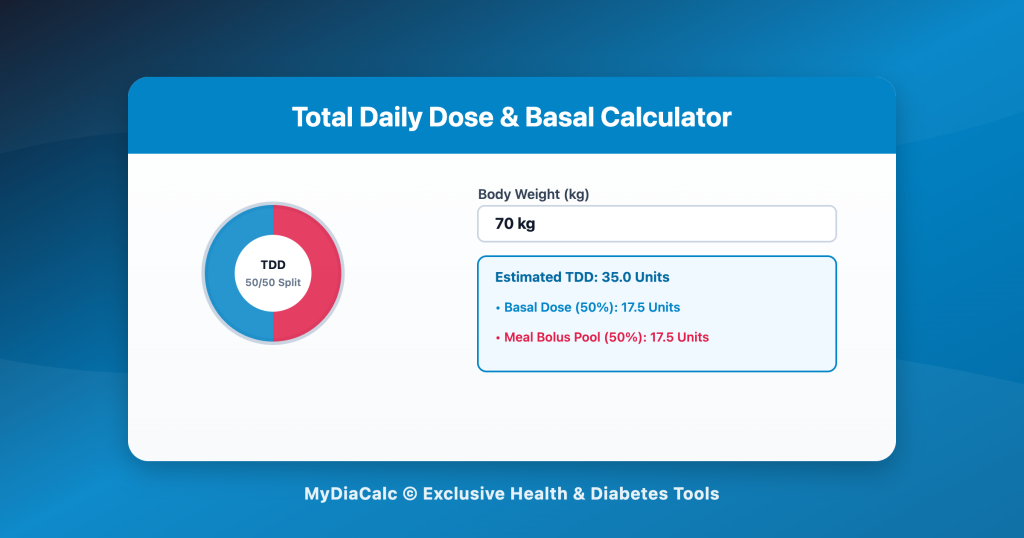
In healthy physiology, the pancreas continuously secretes low background levels of insulin alongside surges during meal consumption. In insulin replacement therapy, clinicians emulate this natural balance by splitting the TDD into approximately 50% Basal Insulin and 50% Bolus Insulin.
2. General Principles for Estimating TDD Based on Weight
In clinical endocrinology, initial TDD estimation heavily relies on body weight and individualized metabolic factors:
- Adults with Type 1 Diabetes (Typical Starting Baseline): 0.4\text{ to }0.6\text{ units} of insulin per kilogram of body weight (\text{units/kg/day}).
- Honeymoon Phase / High Sensitivity: 0.2\text{ to }0.4\text{ units/kg/day}.
- Puberty, Stress, or Significant Insulin Resistance: 0.7\text{ to }1.0+\text{ units/kg/day}.
- Type 2 Diabetes with Insulin Resistance: Starting ranges vary broadly depending on residual beta-cell function, often beginning at 0.2\text{ to }0.5\text{ units/kg/day}.
The MyDiaCalc engine uses the standard clinical starting benchmark of 0.5\text{ units/kg/day} to provide a balanced baseline for educational comparison.
3. The Mathematics of TDD and Basal Allocation
The mathematical equations utilized by clinical calculators to estimate starting parameters operate as follows:
Step 1: Weight Standardised to Kilograms
If weight is provided in pounds (\text{lbs}):
\text{Weight (kg)} = \text{Weight (lbs)} \times 0.453592
Step 2: Total Daily Dose Calculation
Using standard clinical baseline (0.5\text{ units/kg}):
\text{TDD (Units)} = \text{Weight (kg)} \times 0.5
Step 3: Basal vs. Bolus 50/50 Split
To maintain physiological balance:
\text{Basal Insulin (Units)} = \text{TDD} \times 0.50 \text{Total Meal Bolus Pool (Units)} = \text{TDD} \times 0.50
🚨 IMPORTANT MEDICAL DISCLAIMER & LIMITATION OF LIABILITY (2/3): We repeatedly stress: MyDiaCalc EXPRESSLY DISCLAIMS ALL LEGAL AND MEDICAL RESPONSIBILITY for any inaccuracies in user input, weight conversions, or mathematical discrepancies. Administering excess basal insulin can cause severe nocturnal hypoglycemia, whereas insufficient basal insulin can trigger hyperglycemia and ketoacidosis. Always confirm dosage modifications with your endocrinologist.
4. Practical Clinical Scenarios
To illustrate how TDD calculations function across different body weights, consider these three examples:
Scenario A: Individual Weighing 60 kg (132 lbs)
- Calculated TDD: 60\text{ kg} \times 0.5 = 30\text{ units/day}.
- Basal Insulin (50%): 15\text{ units} of long-acting insulin once daily (or divided).
- Total Meal Bolus (50%): 15\text{ units} distributed across daily meals (e.g., ~5 units per meal).
Scenario B: Individual Weighing 80 kg (176 lbs)
- Calculated TDD: 80\text{ kg} \times 0.5 = 40\text{ units/day}.
- Basal Insulin (50%): 20\text{ units} of long-acting insulin.
- Total Meal Bolus (50%): 20\text{ units} distributed across daily meals.
Scenario C: Individual Weighing 100 kg (220 lbs)
- Calculated TDD: 100\text{ kg} \times 0.5 = 50\text{ units/day}.
- Basal Insulin (50%): 25\text{ units} of long-acting insulin.
- Total Meal Bolus (50%): 25\text{ units} distributed across daily meals.
5. Fine-Tuning Basal Insulin: Signs Your Basal Rate Needs Adjustment
Basal insulin is meant to keep blood sugar completely stable during periods of fasting (such as overnight or between meals). It should not be used to cover food carbohydrates or fix high blood sugar spikes.
Signs Your Basal Insulin May Be Too High:
- Frequent blood sugar drops overnight or during fasting periods.
- Needing to eat snacks between meals without taking insulin just to prevent low blood sugar.
Signs Your Basal Insulin May Be Too Low:
- Blood sugar rises continuously overnight or during long periods without eating.
- Waking up in the morning with high fasting blood glucose despite going to bed within target.
6. Frequently Asked Questions (FAQ)
What long-acting insulins are typically used for basal coverage?
Common basal insulins include Insulin Glargine (Lantus, Toujeo, Basaglar), Insulin Detemir (Levemir), and Insulin Degludec (Tresiba).
Can the basal-bolus split be different from 50/50?
Yes. While 50/50 is the ideal starting framework, individual diet choices (such as low-carb or high-carb diets) can adjust the split to 40/60 or 60/40 under medical guidance.
🚨 FINAL MEDICAL DISCLAIMER & LIMITATION OF LIABILITY (3/3): By using MyDiaCalc and its online calculation tools, you explicitly acknowledge and agree that MyDiaCalc and its management hold ZERO LIABILITY OR RESPONSIBILITY for your medical outcomes, dosage choices, or health actions. Always rely on trained medical professionals for clinical guidance.
Content & Calculators Powered by MyDiaCalc © All Rights Reserved.