
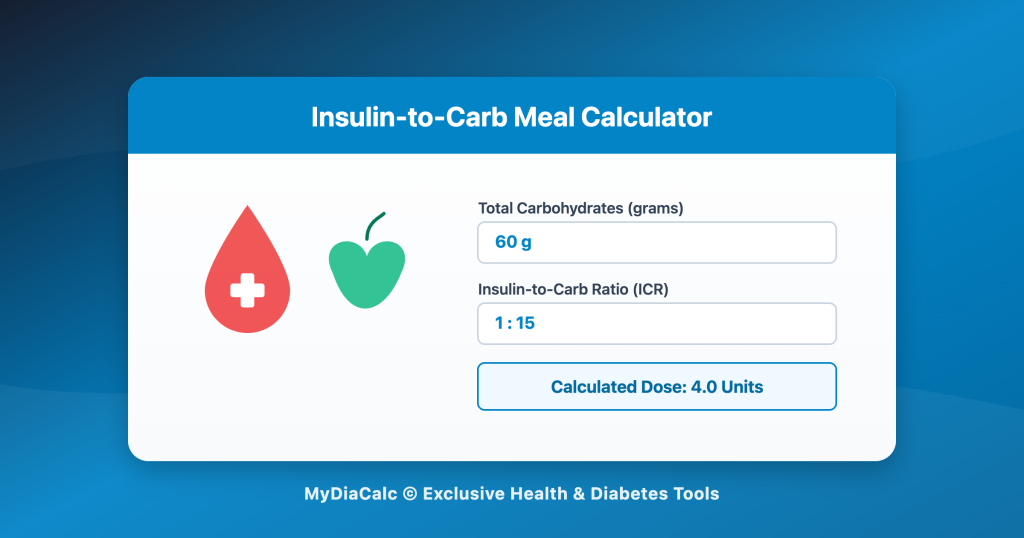
1️⃣ Insulin-to-Carb Meal Calculator
The Definitive Guide to Mealtime Insulin Dosing: Master the Insulin-to-Carb Meal Calculator
Navigating life with insulin-dependent diabetes requires daily calculations, precise choices, and continuous attention to macronutrient intake. Among all daily responsibilities, calculating mealtime bolus insulin accurately stands out as one of the most vital tasks for maintaining optimal health. The Insulin-to-Carb Meal Calculator provided by MyDiaCalc was engineered to simplify this math, giving individuals living with diabetes, caregivers, and medical students a dependable tool for instant estimation.
> 🚨 CRITICAL MEDICAL DISCLAIMER & LIMITATION OF LIABILITY (1/3):
> MyDiaCalc, its owners, developers, and operators ARE NOT RESPONSIBLE or legally liable for any insulin administration, medical choices, dosage inaccuracies, or adverse health outcomes resulting from the use of this tool or reading this article.
> All content and mathematical calculations provided by MyDiaCalc are strictly for informational and educational purposes only. They do not constitute professional medical advice, clinical diagnosis, or individualized treatment strategies. Always consult your certified physician, endocrinologist, or diabetes care team before making any adjustments to your prescribed insulin doses.
>
1. Understanding Carbohydrate Counting and Insulin
Carbohydrates are the primary macro-nutrient found in food that directly converts into glucose during digestion, causing blood sugar levels to rise. When a person without diabetes eats, the pancreas automatically releases an exact quantity of insulin to transport glucose out of the blood and into cells for energy. In insulin-dependent diabetes (Type 1 diabetes and insulin-requiring Type 2 diabetes), this mechanism must be replaced manually.
To achieve post-meal stability, individuals match rapid-acting insulin (such as Novolog, Humalog, Apidra, Fiasp, or Lyumjev) with the grams of carbohydrates consumed. This matching process relies entirely on a clinical ratio known as the Insulin-to-Carbohydrate Ratio (ICR).
2. What Is the Insulin-to-Carb Ratio (ICR)?
Your Insulin-to-Carb Ratio (ICR) defines how many grams of carbohydrates are processed or covered by 1 unit of rapid-acting insulin.
For instance:
* An ICR of 1:10 means 1 unit of insulin is required for every 10 grams of carbohydrates.
* An ICR of 1:15 means 1 unit of insulin covers 15 grams of carbohydrates.
* An ICR of 1:8 means 1 unit of insulin covers 8 grams of carbohydrates.
Why Ratios Vary Among Individuals
Every human metabolism is unique. Factors influencing your ICR include:
* Insulin Sensitivity: Active or younger individuals often have higher sensitivity (e.g., 1:20), needing less insulin per carb gram.
* Insulin Resistance: Conditions like PCOS, obesity, or physical inactivity lower sensitivity (e.g., 1:6), requiring more insulin per carb gram.
* Time of Day: Hormonal rhythms mean many people experience higher resistance in the morning (the “Dawn Phenomenon”), requiring a lower ratio at breakfast (e.g., 1:8) than at dinner (e.g., 1:15).
3. How the MyDiaCalc Meal Dose Calculator Operates
The mathematical formula used by healthcare professionals and integrated into MyDiaCalc is straight-forward and reliable:
Step-by-Step Instructions:
* Calculate Total Carbs: Read the nutritional packaging or weigh food to sum up the total grams of carbs for your meal.
* Enter Carbs into MyDiaCalc: Type the calculated carb value into the Total Carbohydrates field.
* Enter Your Physician-Prescribed ICR: Input your assigned ICR value into the Insulin-to-Carb Ratio field.
* Generate Your Estimate: Click Calculate Meal Dose to view the estimated bolus requirement rounded to one decimal place.
> 🚨 IMPORTANT MEDICAL DISCLAIMER & LIMITATION OF LIABILITY (2/3):
> We repeatedly emphasize: MyDiaCalc EXPRESSLY DISCLAIMS ALL LIABILITY for any errors in input, algorithmic discrepancies, or personal health consequences.
> Food labeling rules vary globally, and actual carb values may differ from package estimates. Never administer insulin based solely on online calculators without double-checking calculations against your medical team’s guidelines.
>
4. In-Depth Calculation Scenarios
To help illustrate how this calculation applies to real-world dining, consider these three detailed examples:
Scenario A: A balanced lunch
* Meal: Whole-grain chicken sandwich (32g carbs) + medium apple (19g carbs) = 51g Total Carbohydrates.
* Assigned Ratio: 1:12
* Formula: 51 \div 12 = 4.25\text{ units}
* Action: Depending on whether your delivery device uses half-units or whole units, you would round to 4.0 or 4.5 units as advised by your physician.
Scenario B: High-carbohydrate dinner
* Meal: Plate of pasta with tomato sauce (75g carbs) + garlic bread (25g carbs) = 100g Total Carbohydrates.
* Assigned Ratio: 1:10
* Formula: 100 \div 10 = 10.0\text{ units}
* Action: The calculated meal bolus is 10 units.
Scenario C: Small afternoon snack
* Meal: Granola bar (18g carbs) + cup of milk (12g carbs) = 30g Total Carbohydrates.
* Assigned Ratio: 1:15
* Formula: 30 \div 15 = 2.0\text{ units}
* Action: The calculated meal bolus is 2 units.
5. Key Dietary Factors Affecting Insulin Absorption
While carb counting forms the foundation of mealtime management, other macronutrients affect how blood glucose behaves over time:
High Fat and High Protein Content
Meals high in fat (e.g., pizza, burgers, fried food) delay stomach emptying. This slow digestion means carbohydrates absorb into the blood much slower than rapid-acting insulin peaks. Giving a full dose immediately before a high-fat meal can lead to early low blood sugar (hypoglycemia) followed hours later by high blood sugar (hyperglycemia).
Dietary Fiber
Dietary fiber is a carbohydrate that the human body cannot fully digest. When eating high-fiber foods (5g or more of fiber per serving), many clinicians recommend subtracting the dietary fiber from the total carbohydrates to calculate “Net Carbs” before running your dosage calculation.
6. Best Practices for Safe Insulin Administration
* Pre-bolus Timing: Most rapid-acting insulins should be administered 15 to 20 minutes before eating to align insulin activity peaks with digestion spikes.
* Track Active Insulin (IOB): Avoid overlapping doses (“insulin stacking”). Giving meal insulin when previous correction doses are still active can cause rapid drops in blood glucose.
* Re-evaluate Ratios Periodically: Body weight changes, stress, changes in activity level, and seasonal variations can alter your ICR. Review your blood sugar logs with your medical provider regularly.
7. Frequently Asked Questions (FAQ)
Does this calculator account for high starting blood sugar?
No. This tool calculates the meal dose only. If your pre-meal blood glucose is above target, you may require an additional correction dose based on your Insulin Sensitivity Factor (ISF). You can use our dedicated Correction Dose Calculator on MyDiaCalc to estimate high blood sugar corrections.
Can I use this calculator for long-acting basal insulin?
No. Basal insulin (such as Lantus, Levemir, Tresiba, or Toujeo) provides 24-hour background coverage and is never calculated using meal carbohydrates or ICR ratios.
> 🚨 FINAL MEDICAL DISCLAIMER & LIMITATION OF LIABILITY (3/3):
> By utilizing the tools and reading the guides on MyDiaCalc, you explicitly acknowledge that you understand and agree that MyDiaCalc holds ZERO RESPONSIBILITY OR LIABILITY for your health outcomes, dosage decisions, or clinical management. Always consult a licensed diabetes health specialist for personal medical advice.
>
Content & Calculators Powered by MyDiaCalc © All Rights Reserved.