
Fat & Protein Bolus Calculator
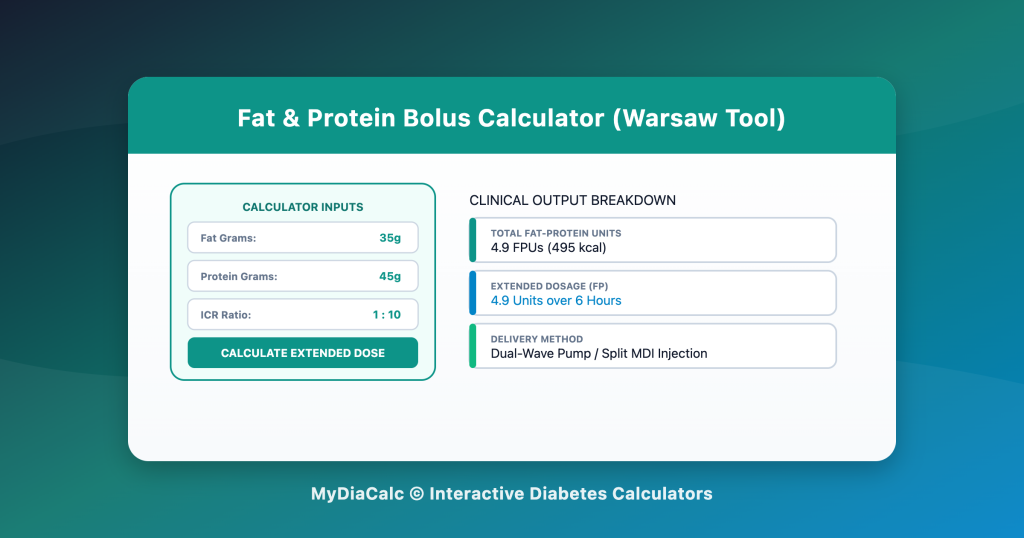
Calculate extended insulin doses for high-fat & high-protein meals using the Warsaw System (FPUs).
🚨 Important Clinical Note:
Fat and protein dosing requires an active insulin pump (Dual-Wave) or split MDI injections. Always start conservatively (e.g., covering 50% of calculated units) and consult your endocrinologist before adjusting settings.
Dosing Breakdown & Delivery Recommendation
💡 Recommended Delivery Strategy:
- Insulin Pump Users: Program a Dual-Wave/Combination bolus with 0% immediate and 100% extended over 0 hours.
- Pen (MDI) Users: Administer the immediate carbohydrate dose pre-meal, then inject the extended dose 1.5 to 2.5 hours after starting the meal.
Mastering Extended Insulin Dosing for High-Fat and High-Protein Meals
When managing insulin-requiring diabetes (Type 1 diabetes, Latent Autoimmune Diabetes in Adults, or insulin-dependent Type 2 diabetes), carbohydrate counting is typically the first skill mastered. Carbohydrates have the most immediate and pronounced effect on postprandial (after-meal) blood glucose levels, converting directly into systemic glucose within 15 to 90 minutes.
However, many individuals face a common clinical challenge: accurately counting carbohydrates for complex, macronutrient-dense meals—such as pizza, burgers, barbecue, or rich pasta dishes—often results in early post-meal hypoglycemia, followed by severe, prolonged hyperglycemia 3 to 8 hours later.
This frustrating phenomenon occurs because dietary fats and proteins alter digestion kinetics and insulin sensitivity. The MyDiaCalc Fat & Protein Bolus Calculator utilizes the clinically validated Warsaw System to calculate additional insulin coverage for dietary fats and proteins, helping you deliver extended or split boluses that match slow digestion curves.
The Physiology: Why Do Fat and Protein Cause Late Glucose Spikes?
To optimize mealtime insulin dosing, it is crucial to understand how lipids (fats) and amino acids (proteins) interact with human metabolism:
1. Delayed Gastric Emptying (The “Pizza Effect”)
Dietary fats slow gastrointestinal motility and delay stomach emptying. When carbohydrates are consumed alongside high amounts of dietary fat, the absorption of those carbohydrates is delayed. A standard pre-meal insulin bolus reaches its peak activity within 60 to 90 minutes—well before the delayed carbohydrates enter the bloodstream. This insulin-to-carbohydrate mismatch causes an initial drop in blood glucose, followed by a late spike hours later after the insulin has expired.
2. Lipid-Induced Insulin Resistance
High circulating levels of Free Fatty Acids (FFAs) following a lipid-rich meal induce transient peripheral and hepatic insulin resistance. This means that your body requires a higher total quantity of insulin to clear the same amount of glucose over an extended timeframe.
3. Protein Gluconeogenesis
Unlike carbohydrates, digested protein does not cause an immediate sharp rise in blood sugar. However, the liver converts approximately 50% to 60% of absorbed amino acids into glucose through gluconeogenesis. This process occurs slowly, gradually raising blood glucose levels over a 3-to-8-hour window. Additionally, ingested protein stimulates pancreatic alpha cells to release glucagon, triggering glycogen release from the liver.
What is the Warsaw System and Fat-Protein Units (FPUs)?
Developed by pediatric endocrinologist Dr. Tomasz Pańkowska and her research team, the Warsaw System is an advanced clinical dosing algorithm designed to quantify insulin needs for non-carbohydrate macronutrients.
The algorithm introduces the concept of Fat-Protein Units (FPUs):
- 1 Fat-Protein Unit (FPU) is defined as 100 Calories derived exclusively from dietary fat and protein.
- In terms of metabolic impact, 1 FPU requires the equivalent insulin coverage of 10 grams of carbohydrates, based on your personal Insulin-to-Carbohydrate Ratio (ICR).
The Caloric Breakdown:
- 1 Gram of Fat = 9\text{ Calories}
- 1 Gram of Protein = 4\text{ Calories}
The Mathematical Formula:
\text{Fat/Protein Calories} = (\text{Fat Grams} \times 9) + (\text{Protein Grams} \times 4) \text{Total FPUs} = \frac{\text{Fat/Protein Calories}}{100} \text{Extended Insulin Dose (Units)} = \text{Total FPUs} \times \left( \frac{10}{\text{ICR Value}} \right)
Recommended Delivery Strategies and Durations
Because fat and protein digest slowly over several hours, administering the entire calculated dose as an immediate pre-meal bolus carries a high risk of acute hypoglycemia. The total Fat-Protein Unit (FPU) count dictates the recommended time window over which the extended insulin should be delivered:
| Total Fat-Protein Units (FPUs) | Caloric Yield (Fat + Protein) | Recommended Extension Duration |
| 1 FPU | 100\text{ kcal} | Extend over 3 Hours |
| 2 FPUs | 200\text{ kcal} | Extend over 4 Hours |
| 3 FPUs | 300\text{ kcal} | Extend over 5 Hours |
| > 3\text{ FPUs} | > 300\text{ kcal} | Extend over 6 to 8 Hours |
How to Administer Based on Your Device:
- Insulin Pump Users (Dual-Wave / Combination Bolus): Program your insulin pump to deliver the carbohydrate insulin immediately (15 to 20 minutes pre-meal) and spread the calculated Fat-Protein dose evenly over the recommended duration (e.g., 4 to 6 hours).
- Multiple Daily Injection (MDI / Pen Users): Inject your standard carbohydrate dose pre-meal. To cover the fat and protein without an insulin pump, administer a second injection containing the extended Fat-Protein units 1.5 to 2.5 hours after starting the meal.
Step-by-Step: How to Use the Calculator
- Enter Fat Grams: Input the total fat content of your meal (in grams) using nutritional labels or digital food scales.
- Enter Protein Grams: Input the total protein content of your meal (in grams).
- Enter Carbohydrates (Optional): Input carbohydrate grams if you wish to calculate your immediate pre-meal bolus simultaneously.
- Enter Your Personal ICR: Input your active Insulin-to-Carbohydrate Ratio (e.g., enter 10 if your ratio is 1:10).
- Click Calculate: The tool will instantly display your total FPUs, recommended extended dose, immediate carbohydrate dose, and exact delivery timeframes.
Safety Guidelines and Clinical Best Practices
While calculating fat and protein coverage can significantly improve Time-in-Range (TIR) and flatten postprandial glucose curves, safety must remain your highest priority:
- ⚠️ Start Conservatively (The 50% Rule): When using the Warsaw method for the first time, deliver only 50% of the calculated extended dose. Monitor your Continuous Glucose Monitor (CGM) trends for several trial meals before gradually advancing to 75% or 100% of the calculated dose.
- ⚠️ Verify Basal Rates First: Never test extended fat-protein dosing when background basal insulin rates are unstable or inaccurate.
- ⚠️ Automated Insulin Delivery (AID) Systems: If you use an automated closed-loop system (such as Control-IQ, Omnipod 5, or CamAPS FX), consult your endocrinologist. Automated algorithms often adjust basal delivery upward to manage late spikes automatically, which may reduce the need for manual extended boluses.
🚨 Medical Disclaimer: The MyDiaCalc Fat & Protein Bolus Calculator is designed for educational and informational purposes only. It does not provide medical advice or establish clinical treatment regimens. Always consult your endocrinologist or Certified Diabetes Care and Education Specialist (CDCES) before making adjustments to your insulin therapy.

Pingback: Fat and Protein Dosing in Diabetes: When, Why, and How to Calculate Extended Boluses - MyDiaCalc