Correction Dose Calculator
The Complete Medical & Practical Guide to High Blood Sugar Corrections: How to Master the Correction Dose Calculator
Unexplained high blood sugar spikes (hyperglycemia) are an unavoidable reality of living with insulin-dependent diabetes. Even with disciplined carbohydrate counting, healthy nutritional choices, and precise basal insulin coverage, blood glucose levels can fluctuate due to stress, hormonal shifts, minor illnesses, or unexpected digestive delays. Understanding how to manage hyperglycemia safely using rapid-acting insulin is critical for long-term health and for avoiding immediate complications such as Diabetic Ketoacidosis (DKA).
The Correction Dose Calculator provided by MyDiaCalc is an advanced mathematical tool designed to help individuals living with diabetes, caregivers, and medical professionals quickly estimate the precise amount of rapid-acting insulin required to return elevated blood glucose to a healthy target range.
🚨 CRITICAL MEDICAL DISCLAIMER & LIMITATION OF LIABILITY (1/3): MyDiaCalc, its owners, operators, and developers ARE NOT RESPONSIBLE OR LIABLE for any medical decisions, dosage adjustments, insulin administration errors, or health complications resulting from the use of this tool or reading this guide. All content, formulas, and results on MyDiaCalc are provided strictly for educational and informational purposes only. They do not constitute professional medical advice, clinical diagnosis, or individualized treatment protocols. Always consult your physician, endocrinologist, or certified diabetes care team before making any changes to your insulin regimens or correction guidelines.
1. What Is an Insulin Correction Dose?
In diabetes management, insulin doses are generally categorized into three types:
- Basal Insulin: Background insulin delivered slowly to manage resting metabolic functions over 12 to 24 hours.
- Meal Bolus Insulin: Rapid-acting insulin taken before meals to offset incoming carbohydrates from food.
- Correction Bolus Insulin: Additional rapid-acting insulin administered between meals or when fasting to lower unexpectedly high blood sugar back into target range.
Unlike a meal dose, a correction dose does not cover future carbohydrate intake. Its sole purpose is to clear excess circulating glucose from the bloodstream and restore normal glycemic balance.
2. Understanding the Insulin Sensitivity Factor (ISF)
To calculate an effective correction dose, you must know your personal Insulin Sensitivity Factor (ISF), which is also commonly known as a Correction Factor (CF).
Your ISF represents how many milligrams per deciliter (\text{mg/dL}) your blood glucose level is expected to drop in response to 1 unit of rapid-acting insulin.
Key Principles of ISF:
- High Sensitivity: An ISF of 80 means 1 unit of rapid-acting insulin will lower your blood sugar by 80\text{ mg/dL}. Individuals with high sensitivity require smaller correction doses.
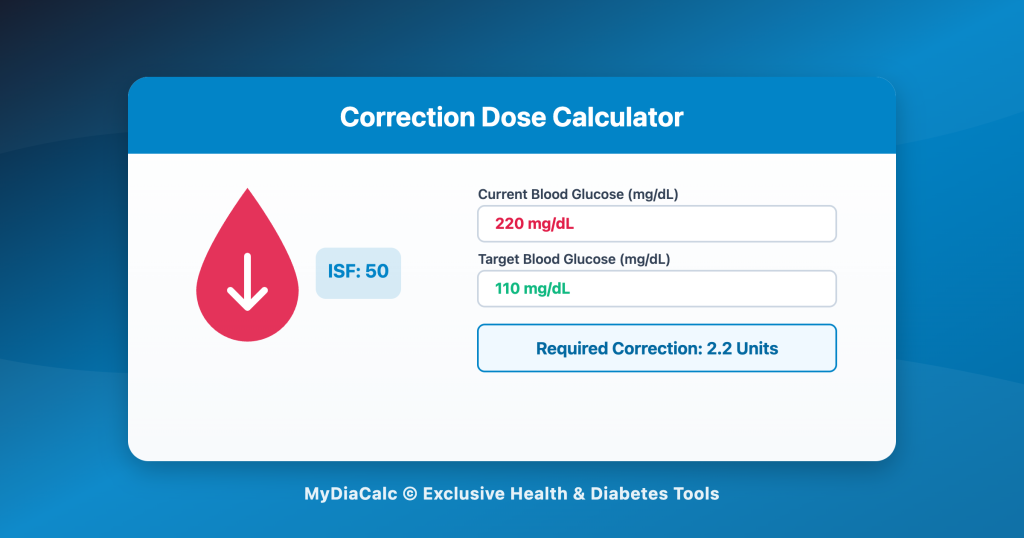
- Moderate Sensitivity: An ISF of 50 means 1 unit lowers blood glucose by 50\text{ mg/dL}.
- Low Sensitivity (Insulin Resistance): An ISF of 20 means 1 unit lowers blood glucose by only 20\text{ mg/dL}. Individuals with higher insulin resistance require larger correction doses to lower their glucose.
Your endocrinologist calculates your ISF based on your daily total insulin dosage, overall body weight, and clinical history using rules such as the Rule of 1800 (for rapid-acting insulins like Novolog or Humalog).
3. The Mathematical Formula Behind Correction Calculations
The mathematical equation utilized by clinical endocrinologists and embedded directly into the MyDiaCalc calculation engine is expressed as follows:
\text{Correction Dose (Units)} = \frac{\text{Current Blood Glucose} – \text{Target Blood Glucose}}{\text{Insulin Sensitivity Factor (ISF)}}
Step-by-Step Practical Calculation Guide:
- Measure Current Blood Glucose: Test your blood glucose level using a continuous glucose monitor (CGM) or fingerstick glucometer.
- Identify Your Target Glucose: Determine your desired target blood sugar level as designated by your clinical team (e.g., 100\text{ mg/dL} or 110\text{ mg/dL}).
- Determine Your Exceeded Glucose: Subtract your target blood glucose from your current blood glucose reading.
- Divide by Your ISF: Divide that difference by your personal ISF value to determine the exact correction dose in units.
🚨 IMPORTANT MEDICAL DISCLAIMER & LIMITATION OF LIABILITY (2/3): We repeatedly stress: MyDiaCalc EXPRESSLY DISCLAIMS ALL LEGAL AND MEDICAL RESPONSIBILITY for any inaccuracies in user input, mathematical discrepancies, or adverse medical events. Administering excessive insulin can cause severe, life-threatening low blood sugar (hypoglycemia). Always double-check your numbers and consult your clinical healthcare provider to confirm your personal ISF and target ranges.
4. Realistic Calculation Scenarios
To better understand how this formula functions during daily diabetes care, consider these three detailed scenarios:
Scenario A: Moderate High Sugar Between Meals
- Current Blood Glucose: 230\text{ mg/dL}
- Target Blood Glucose: 110\text{ mg/dL}
- Assigned ISF: 40\text{ mg/dL} per unit
- Calculation Step 1: 230 – 110 = 120\text{ mg/dL} excess glucose.
- Calculation Step 2: 120 \div 40 = 3.0\text{ units}.
- Estimated Result: A correction dose of 3 units is required.
Scenario B: High Fasting Sugar in the Morning
- Current Blood Glucose: 195\text{ mg/dL}
- Target Blood Glucose: 100\text{ mg/dL}
- Assigned ISF: 50\text{ mg/dL} per unit
- Calculation Step 1: 195 – 100 = 95\text{ mg/dL} excess glucose.
- Calculation Step 2: 95 \div 50 = 1.9\text{ units}.
- Estimated Result: A correction dose of approximately 1.9 to 2 units is required.
Scenario C: Severe Hyperglycemia Due to Missed Dose
- Current Blood Glucose: 320\text{ mg/dL}
- Target Blood Glucose: 120\text{ mg/dL}
- Assigned ISF: 30\text{ mg/dL} per unit
- Calculation Step 1: 320 – 120 = 200\text{ mg/dL} excess glucose.
- Calculation Step 2: 200 \div 30 = 6.66\text{ units}.
- Estimated Result: A correction dose of 6.5 to 6.7 units is indicated (depending on syringe/pen precision).
5. The Dangerous Trap of Insulin Stacking
One of the most frequent errors in high blood sugar management is insulin stacking.
Rapid-acting insulin formulations typically take 15 to 30 minutes to begin working, reach peak activity between 1.5 and 2 hours, and remain active in the human body for 3 to 5 hours (referred to as Insulin On Board – IOB).
If an individual checks their blood sugar 1 hour after taking insulin and sees that it is still elevated, taking a second full correction dose causes the doses to stack. Once both doses reach peak activity simultaneously, blood sugar can drop precipitously, causing severe hypoglycemia.
Rules for Avoiding Insulin Stacking:
- Wait at least 3 to 4 hours between rapid-acting correction doses unless directed otherwise by your endocrinologist.
- Account for active Insulin On Board (IOB) using an insulin pump or smart pen before adding another correction dose.
- Stay well hydrated with water, which helps the kidneys flush out excess glucose naturally through urine.
6. Frequently Asked Questions (FAQ)
What rapid-acting insulins work with this correction formula?
This formula applies to rapid-acting analog insulins such as insulin lispro (Humalog, Lyumjev), insulin aspart (Novolog, Fiasp), and insulin glulisine (Apidra), as well as short-acting regular insulin (with appropriate adjustments for slower absorption timing).
Can I combine a correction dose with a meal dose?
Yes. If your blood glucose is elevated prior to a meal, your total pre-meal insulin requirement is the sum of your Meal Bolus plus your Correction Bolus.
🚨 FINAL MEDICAL DISCLAIMER & LIMITATION OF LIABILITY (3/3): By using MyDiaCalc and its online calculation tools, you explicitly acknowledge and agree that MyDiaCalc and its management hold ZERO LIABILITY OR RESPONSIBILITY for your medical outcomes, dosage choices, or health actions. Always rely on trained medical professionals for clinical guidance.
Content & Calculators Powered by MyDiaCalc © All Rights Reserved.