eAG to HbA1c Converter
Understanding HbA1c and Estimated Average Glucose (eAG): The Clinical Guide & Converter
Managing diabetes effectively requires evaluating both short-term daily blood glucose swings and long-term glycemic control. While daily fingerstick tests and Continuous Glucose Monitors (CGM) give real-time snapshots of your blood sugar, the Hemoglobin A1c (HbA1c) test provides a critical picture of average blood sugar over the preceding 2 to 3 months.
However, interpreting HbA1c percentage values can sometimes feel disconnected from the daily milligrams per deciliter (\text{mg/dL}) or millimoles per liter (\text{mmol/L}) numbers seen on glucose meters. To bridge this gap, the American Diabetes Association (ADA) introduced Estimated Average Glucose (eAG).
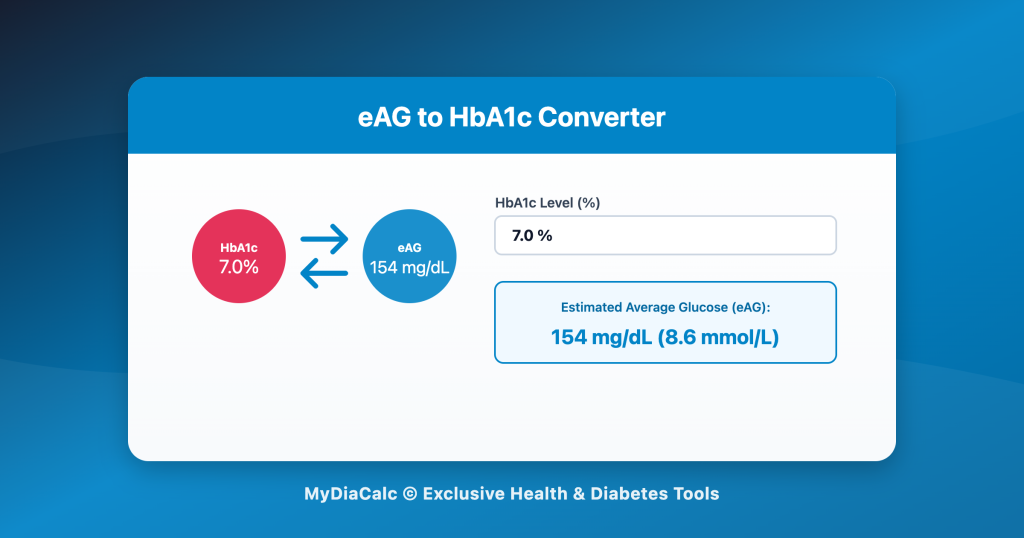
The eAG to HbA1c Converter by MyDiaCalc allows patients, clinicians, and diabetes educators to seamlessly convert HbA1c percentages into actionable daily glucose averages, and vice versa.
🚨 CRITICAL MEDICAL DISCLAIMER & LIMITATION OF LIABILITY (1/3): MyDiaCalc, its owners, operators, and developers ARE NOT RESPONSIBLE OR LIABLE for any diagnostic interpretation, clinical decisions, or treatment protocols resulting from the use of this tool or reading this guide. All mathematical results and medical explanations provided by MyDiaCalc are strictly for educational and informational purposes only. They do not replace laboratory testing or clinical evaluation. Always consult your physician, endocrinologist, or certified diabetes care team regarding your laboratory results.
1. What Is HbA1c and How Is It Measured?
Hemoglobin is a protein inside red blood cells responsible for transporting oxygen throughout the human body. When glucose enters the bloodstream, a portion of it naturally attaches to hemoglobin molecules in a process called glycation.
Because red blood cells have a average lifespan of approximately 120 days (4 months), measuring the percentage of glycated hemoglobin (\text{HbA1c}) reflects average circulating blood glucose levels over the past 8 to 12 weeks.
- Normal Range: Below 5.7%
- Prediabetes: 5.7% to 6.4%
- Diabetes Diagnosis: 6.5% or higher
- General ADA Target for Adults with Diabetes: Below 7.0% (individualized targets vary).
2. What Is Estimated Average Glucose (eAG)?
While doctors frequently speak in HbA1c percentages (e.g., “Your A1c is 7.2%”), patients monitor their diabetes daily using \text{mg/dL} or \text{mmol/L} values.
Estimated Average Glucose (eAG) translates laboratory HbA1c percentage results into the exact same unit of measurement shown on daily glucose meters. For example, an HbA1c of 7.0% corresponds to an eAG of 154 mg/dL (8.6 mmol/L).
Understanding your eAG makes laboratory blood tests directly relatable to your daily CGM graphs and fingerstick readings.
3. The Clinical ADAG Formula Behind the Calculation
The relationship between HbA1c and average glucose was established through the landmark A1c-Derived Average Glucose (ADAG) Study, published by the American Diabetes Association (ADA) and the European Association for the Study of Diabetes (EASD).
The standardized mathematical formula used by MyDiaCalc to calculate eAG from HbA1c is expressed as:
\text{eAG (mg/dL)} = (28.7 \times \text{HbA1c}) – 46.7
To convert eAG back into an estimated HbA1c percentage, the algebraic inverse formula is applied:
\text{HbA1c (\%)} = \frac{\text{eAG (mg/dL)} + 46.7}{28.7}
To convert \text{mg/dL} to \text{mmol/L} (used internationally):
\text{eAG (mmol/L)} = \frac{\text{eAG (mg/dL)}}{18.0182}
🚨 IMPORTANT MEDICAL DISCLAIMER & LIMITATION OF LIABILITY (2/3): We repeatedly emphasize: MyDiaCalc EXPRESSLY DISCLAIMS ALL LEGAL AND MEDICAL LIABILITY for inaccuracies resulting from underlying medical conditions. Conditions that affect red blood cell lifespan—such as anemia, hemoglobinopathies (e.g., sickle cell trait), recent blood transfusions, pregnancy, or severe kidney disease—can alter HbA1c accuracy. Always verify laboratory results with a qualified physician.
4. Reference Table: HbA1c to eAG Conversion Chart
Below is a quick reference guide demonstrating how HbA1c levels correspond directly to estimated average glucose:
| HbA1c (%) | eAG (mg/dL) | eAG (mmol/L) | Clinical Category |
| 5.0% | 97 mg/dL | 5.4 mmol/L | Normal |
| 6.0% | 126 mg/dL | 7.0 mmol/L | Prediabetes |
| 6.5% | 140 mg/dL | 7.8 mmol/L | Diabetes Threshold |
| 7.0% | 154 mg/dL | 8.6 mmol/L | ADA Target |
| 8.0% | 183 mg/dL | 10.1 mmol/L | Above Target |
| 9.0% | 212 mg/dL | 11.8 mmol/L | High Risk |
| 10.0% | 240 mg/dL | 13.3 mmol/L | Uncontrolled |
5. Practical Application: Bridging CGM Time-in-Range with HbA1c
Continuous Glucose Monitor (CGM) users often notice a slight difference between their CGM’s Glucose Management Indicator (GMI) or average glucose reading and their actual laboratory HbA1c test result.
Why does this happen?
- Red Blood Cell Variation: Some individuals have red blood cells that live slightly longer or shorter than the average 120 days.
- Time-in-Range (TIR) Dynamics: CGM devices track glucose continuously every 5 minutes, capturing rapid post-meal spikes that fingerstick tests might miss.
- Lab vs. Sensor Calibration: Laboratory blood drawn from veins uses chemical assays, whereas CGM sensors measure interstitial fluid glucose.
Using the MyDiaCalc converter helps users evaluate whether their sensor average matches clinical expectations before meeting with their endocrinologist.
6. Frequently Asked Questions (FAQ)
Is eAG the exact average of my fingerstick blood tests?
Not always. Fingerstick readings usually occur before meals or when feeling low, missing post-meal peaks and overnight trends. eAG reflects true 24/7 glucose averages.
Why is my HbA1c target different from someone else’s?
Endocrinologists individualize HbA1c targets based on age, duration of diabetes, history of severe hypoglycemia, and underlying cardiovascular health.
🚨 FINAL MEDICAL DISCLAIMER & LIMITATION OF LIABILITY (3/3): By utilizing MyDiaCalc and its online conversion tools, you explicitly agree that MyDiaCalc and its developers hold ZERO LIABILITY OR RESPONSIBILITY for medical outcomes, diagnosis interpretations, or lifestyle adjustments. Consult your endocrinologist for clinical management.
Content & Calculators Powered by MyDiaCalc © All Rights Reserved.